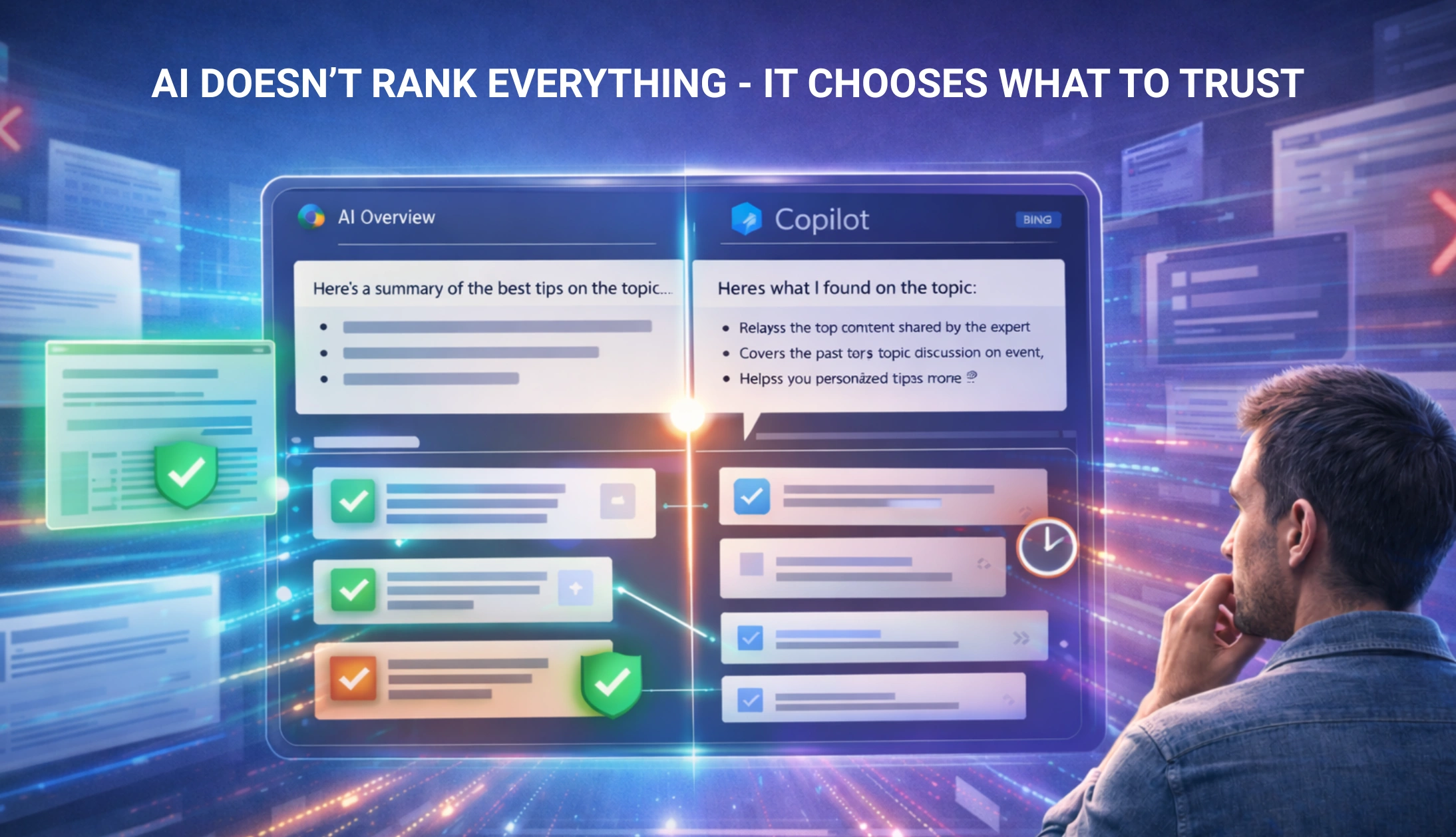
You spent hours on a well-researched blog post. Your competitor published something half as detailed. And Google’s AI Overview quoted them, not you. Sound familiar?
Here is the direct answer: Google SGE (now called AI Overview) and Bing Copilot choose sources based on four core signals: trust, content structure, query relevance, and freshness. But knowing just that is not enough. The real advantage comes from understanding how each signal works and what you can do to optimize for it.
This guide breaks it all down, with real data, clear comparisons, and a step-by-step action plan you can use right now.
What Is Google AI Overview and How Is It Different?
For most of Google’s history, a search returned ten blue links. You clicked, you read, you decided. That model still exists, but something more powerful has been layered on top of it. AI Overview now generates a direct, synthesized answer before you ever reach a single link. Understanding what changed and why it matters is the first step to staying visible.
How Google AI Overview Works
Google AI Overview (formerly Search Generative Experience or SGE) uses Google’s Gemini model to scan multiple web pages, pull out the most relevant information, and present a single coherent answer at the very top of search results. It cites sources below the answer, but most users read the summary and stop. The pages it cites from are selected through a process called query fan-out, where the AI issues multiple sub-searches across related topics to build a comprehensive response.
How Bing Copilot Fits into This Picture
Microsoft’s Bing Copilot integrates OpenAI’s GPT model directly into the search experience. When you search on Bing, you often get a conversational AI answer alongside traditional results. Copilot tends to cite more conversational, long-form sources and is somewhat more flexible about the content types it pulls from. Both tools are solving the same user problem: getting to the answer faster, without unnecessary clicking.
Why This Shift Changes Everything for Content Creators
AI Overview grew from appearing in just 6.49% of searches in January 2025 to over 50% of all queries by October 2025 (The Digital Bloom, 2025). Zero-click searches, where users get their answer directly from the AI without visiting any site, climbed from 56% to 69% of all queries in the same period. This is the same behavioral shift that is reshaping.
How Gen Z consumes content across every platform. If your content is not being cited, it is effectively invisible to a growing portion of your audience.
Figure 1: Google AI Overview Search Coverage Growth (2025)
| Month / Period | AI Overview Coverage (% of all searches) |
|---|---|
| January 2025 |
6%
|
| March 2025 |
16%
|
| July 2025 |
25%
|
| October 2025 |
50%
|
How Does Google AI Overview Choose Sources?
Google AI Overview does not randomly pull from the web. It applies a layered set of quality signals to decide which pages are trustworthy, relevant, and structured well enough to be cited. There are four signals that matter most, and each one gives you a clear area to optimize.
1. Authority and Trustworthiness: The E-E-A-T Framework
E-E-A-T stands for Experience, Expertise, Authoritativeness, and Trustworthiness. It is Google’s core framework for evaluating whether a source deserves to be cited. According to a 2026 analysis of 15,847 AI Overview results, 96% of citations come from sources with demonstrably strong E-E-A-T signals. In practice, this means content written by named authors with relevant credentials, supported by citations, and published on a site with a history of accurate information. Anonymous content with no authorship signals, no references, and no track record rarely makes the cut.
96% of Google AI Overview citations come from sources with strong E-E-A-T signals. (Wellows, Feb 2026)
2. Query Relevance and Long-Tail Matching
AI Overview is especially strong at matching long-tail queries, the kind that read like actual questions. Research from Serpstat shows that 70% of queries that trigger AI Overviews contain ten or more words. When your content directly mirrors the phrasing of real user questions, your chances of being cited go up substantially. A page that asks “how does Google AI Overview choose sources?” in a heading and answers it clearly in the next two sentences is far more likely to be cited than a page that buries that information in paragraph seven.
70% of queries that trigger Google AI Overviews contain 10 or more words. (Serpstat, 2025)
3. Content Structure and Scannability
AI systems do not read content the way humans do. They scan for patterns: clear headers, short paragraphs, bullet points, FAQ sections, and direct answers positioned near the top of each section. Research from Growth Memo (Feb 2026) found that 44.2% of all AI citations come from the first 30% of a page’s text. That means your introduction and first few sections carry the majority of the citation weight. If your best answer is at the bottom of a long article, AI is far less likely to find it.
44.2% of all AI citations are drawn from the first 30% of a page’s content. (Growth Memo, Feb 2026)
4. Content Freshness and Regular Updates
For fast-moving topics like AI search, digital marketing, or technology, freshness is a significant selection factor. A 2026 article with current statistics will almost always outperform a 2022 article covering the same ground, even if the older one is more thorough on fundamentals. This is why a regular content audit strategy, refreshing stats, updating examples, and adding new sections, is one of the highest-return activities in AI SEO and AEO services today.
Table 1: E-E-A-T Signals That Influence AI Overview Citations
| E-E-A-T Signal | What Google Looks For | Quick Win |
| Experience | First-hand knowledge, case studies, real examples | Add author bios with relevant credentials |
| Expertise | Accurate, in-depth, well-sourced content | Cite authoritative external sources |
| Authoritativeness | Backlinks, mentions, brand recognition | Earn links from trusted industry sites |
| Trustworthiness | Transparent authorship, accurate claims, updated content | Add publish and update dates to all posts |
How Does Bing Copilot Give Answers Differently Than Google?
While Google and Bing are both trying to answer questions with AI, they are powered by different models and built on different philosophies. Understanding where they diverge helps you write content that performs across both platforms, not just one.
1. The Core Difference: Indexing and Model Architecture
Google AI Overview draws primarily from Google’s own search index, using Gemini 3 (which became the global default on January 27, 2026) to synthesize information via a query fan-out process. Bing Copilot, on the other hand, runs on Microsoft’s web index combined with OpenAI’s GPT model. This means Bing has access to a different slice of the web and weights conversational, long-form content slightly more generously. The practical implication is that content that performs on one platform will often perform on the other, but you cannot rely on identical behavior.
2. What Both Platforms Share: The Non-Negotiables
Despite their architectural differences, both Google AI Overview and Bing Copilot agree on the fundamentals. Both prioritize authoritative, clearly structured, and query-relevant content. Both tend to favor pages with high domain authority and strong backlink profiles. And both actively penalize content that is thin, vague, or slow to deliver its core answer. If you optimize for these shared principles, you are building for both platforms simultaneously.
3. Citation Overlap: A Significant Gap Between Platforms
One of the most striking findings from recent research is how little citation overlap exists between different AI tools. An Ahrefs study from December 2025 found that only 13.7% of citations overlap between Google AI Overviews and AI Mode alone. Across completely different platforms like Google, Bing, and Perplexity, the overlap is even smaller. This confirms that an omnichannel content strategy is now essential, not optional.
Only 13.7% of citations overlap between Google AI Overviews and Google AI Mode. (Ahrefs, Dec 2025)
Table 2: Google AI Overview vs Bing Copilot Source Selection Compared
| Factor | Google AI Overview | Bing Copilot |
| Underlying AI Model | Google Gemini 3 | OpenAI GPT (via Microsoft) |
| Index Source | Google Search Index | Microsoft Bing Index |
| Content Type Preferred | Structured, authoritative pages | Conversational + long-form |
| Citation Method | Query fan-out process | Conversational retrieval |
| E-E-A-T Weight | Very high | High |
| Freshness Weight | High | High |
| UGC / Forum Content | Limited (Reddit cited) | More flexible |
How AI Tools Choose Answers: The Rules That Apply Everywhere
Whether you are optimizing for Google, Bing, Perplexity, or the next AI search tool that launches next month, a common set of rules governs how all AI tools select their sources. These are the principles that cut across every platform and every industry.
Structured, Digestible Content Always Gets Chosen First
AI tools process content by scanning for structural patterns, not reading for meaning the way a human would. Pages with clear H2 and H3 headings, numbered steps, bullet-pointed summaries, and well-organized tables are significantly more likely to be cited. Research confirms that pages combining text, images, structured data, and video see 156% higher AI selection rates than text-only pages. Think of your content as something a bot needs to extract a clean answer from in under two seconds, because that is essentially what is happening.
Pages combining text + images + structured data see 156% higher AI Overview selection rates. (Wellows, Feb 2026)
Direct Question-and-Answer Format: The Rise of AEO
This is where AEO (Answer Engine Optimization) becomes critical. Unlike traditional SEO, which focuses primarily on keyword ranking, AEO focuses on structuring content so AI can extract clean, direct answers. The gold standard is a heading that asks a question, followed immediately by a two-to-three sentence answer. FAQ sections with schema markup further amplify this signal. Brands that have fully committed to AEO-first content architecture are consistently capturing more AI citations than those still optimizing exclusively for traditional search rankings.
Cited Sources and Topical Authority Through Internal Linking
AI tools trust content that is grounded in a network of evidence. External links to authoritative sources signal that your claims are verifiable. Internal links across related topics signal that your site has genuine depth on a subject, not just one well-written page. Sites with over 32,000 referring domains are 3.5 times more likely to be cited by AI tools than sites with minimal backlink profiles (SE Ranking, Nov 2025). This reinforces why building topical authority across a content cluster, rather than a single isolated post, is one of the highest-leverage activities in AI content optimization.
Sites with 32,000+ referring domains are 3.5x more likely to be cited by AI tools than low-authority domains. (SE Ranking, Nov 2025)
AI-Written vs Human-Written Content: Which Actually Gets Cited?
This is one of the most debated questions in generative AI content marketing right now. The answer is that both can get cited, but with an important condition. AI-written content that goes live without human review, original insight, or added data tends to be shallow and repetitive. It often recycles what already exists online, giving AI systems no reason to prefer it over the sources it was based on. Human-edited content with genuine perspective, original research, and real examples consistently outperforms pure AI output in citation rates. Google’s own guidance is clear: helpful, people-first content wins, regardless of how it was initially drafted.
What This Means for Your Digital Marketing and Content Strategy
The rise of AI-powered search is not just a technical shift for SEO teams. It changes the entire value equation of content marketing, paid search, and brand visibility. Here is what the data says and what smart marketers are doing about it.
1. The CTR Impact: Why Being Cited Matters More Than Ranking
According to Seer Interactive’s September 2025 study analyzing 3,119 queries across 42 organizations, organic click-through rates dropped 61% for queries where AI Overviews appeared, falling from 1.76% to just 0.61%. But there is a stark reversal for cited brands: pages cited inside an AI Overview earn 35% more organic clicks and 91% more paid clicks than competitors on the same query who are not cited. The message is unambiguous. Getting cited in AI answers is now the new page one.
Figure 2: CTR Impact of Google AI Overviews on Organic and Paid Search
| Scenario | CTR Change | What It Means for You |
| Organic CTR (without citation) | -61% | Traffic drops sharply when AI answers appear |
| Paid CTR (without citation) | -68% | Ad spend efficiency collapses without visibility |
| Organic CTR (if cited in AIO) | +35% | Citation more than reverses the organic loss |
| Paid CTR (if cited in AIO) | +91% | Massive multiplier for paid performance |
Source: Seer Interactive study, Sept 2025 (3,119 queries, 42 organizations, 25.1M impressions).
2. AI-Powered Digital Marketing Services and the AEO Opportunity
Traditional SEO focused on ranking. AI-powered digital marketing services are now being rebuilt around being cited. This means structuring content for answer extraction, building topical authority clusters, and tracking share-of-voice in AI answers rather than just position-one rankings. Brands that make this shift now have a significant first-mover advantage, particularly in industries like healthcare (88% AI Overview query coverage), education (83%), and B2B technology (82%), where AI answers dominate almost every search (BrightEdge, Feb 2026).
3. Social Presence Directly Feeds AI Citation Probability
Your visibility in AI search does not live on Google alone anymore. Research from SE Ranking (Nov 2025) found that brands with active profiles on review platforms like Trustpilot, G2, and Yelp are 3x more likely to be cited by AI tools than those without. Brands mentioned frequently on Reddit and Quora show 4x higher citation probability. This means your social presence and community engagement are now direct inputs into AI citation probability. Knowing how to elevate your Instagram reach in 2026 is now an AI SEO strategy, not just a social media one.
How to Optimize Your Content to Be Chosen by Google SGE and Bing Copilot
Theory without action is just reading. Here is a structured, seven-step approach to giving your content the best possible chance of being selected by AI systems. These are ordered by impact, starting with the changes that move the needle fastest.
Your 7-Step AI Citation Optimization Checklist:
1. Write a direct answer in the first 100 words of every section.
AI systems pull from the beginning of content far more than the end. Forty-four percent of all AI citations come from the first third of a page. Put your best answer first, and expand on it after.
2. Use headers that mirror real search queries.
Write headings the way a person would type a question into Google or Bing. “How does Google AI Overview choose sources?” is a better heading than “Our Source Selection Analysis.” Think user intent, not editorial style.
3. Publish original data, expert quotes, or first-hand case studies.
Content that cites verifiable facts from authoritative sources gets 89% higher AI selection probability (Wellows, Feb 2026). Original research and named expert perspectives give AI systems a unique, trustworthy source to cite rather than a summary of what already exists elsewhere.
4. Update older content regularly with current data and examples.
A post from 2023 refreshed with 2026 statistics and new examples will almost always outperform one left untouched. Schedule quarterly content audits as a non-negotiable part of your AI content optimization workflow.
5. Use schema markup to signal answer-ready content.
FAQ schema, HowTo schema, and Article schema all help AI systems identify structured answers on your page. These are not just technical additions. They are direct signals that your page is optimized for answer extraction, which is exactly what AI tools are trying to do.
6. Build topical authority through consistent internal linking.
A deliberate content cluster strategy (think marketing automation vs manual campaign as part of a broader marketing operations hub) tells AI systems that your site covers a topic in depth, not just in isolation. Topical depth is one of the strongest domain-level signals AI tools use.
7. Invest in multimodal content: images, video, and structured data.
Your next customer must be using visual search. Well-tagged images, infographics, and video transcripts all contribute to the multimodal signals that drive 156% higher AI selection rates. Text-only pages are losing ground fast to pages that combine multiple content formats.
Table 3: SEO vs AEO: What Changes and What Stays the Same
| Area | Traditional SEO | AEO (Answer Engine Optimization) |
| Primary Goal | Rank in top 10 results | Get cited inside AI answers |
| Content Format | Keyword-dense paragraphs | Q&A structure, direct first answers |
| Headers | Creative / brand-driven | Query-mirroring (as users search) |
| Success Metric | Position 1 ranking, CTR | Citation frequency, AI share-of-voice |
| Schema Markup | Optional / recommended | Essential for answer extraction |
| Content Freshness | Important | Critical (AI de-prioritizes stale pages) |
| Backlinks | Primary authority signal | Still important + entity / brand signals |
AI Search Is Changing Consumer Behavior. Are You Keeping Up?
The consumer journey has stopped being linear. People discover brands through AI answers, check social profiles, read a blog, and then convert, often without clicking a single traditional search result. If your strategy only accounts for Google rankings, you are missing the majority of how modern buyers actually move.
1. AI Search and Social Media Are Now the Same Strategy
AI social media marketing and AI SEO have merged into a single discipline. Social signals feed domain authority. Domain authority feeds AI citation probability. A brand with strong, consistent engagement across LinkedIn, Instagram, YouTube, and review platforms is far more likely to be trusted by AI systems than one that only maintains a blog. According to Ahrefs research, YouTube mentions in video titles and transcripts are now the single strongest correlating factor with AI Overview visibility among all signals tested.
2. Brand Trust Is Now a Direct AI Ranking Signal
Audiences have become sharper about who they trust and who they follow. The broader shift from de-influencing to re-engaging reflects a demand for authenticity that happens to align perfectly with what AI tools reward. Credible, transparent, experience-backed content is not just good for your audience. It is one of the strongest signals an AI system can use when deciding whether your source is worth citing.
3. AI Search Is Growing Across Industries at Different Rates
AI Overview adoption is not uniform across industries. If you are in healthcare, education, or B2B technology, AI answers are already dominating the majority of relevant queries. For other sectors like ecommerce and entertainment, the rollout is still uneven. Understanding where your industry sits on this curve determines how urgently you need to shift your strategy.
Figure 3: AI Overview Query Coverage by Industry (Feb 2025 to Feb 2026)
| Industry | % of Queries Showing AI Overview |
|---|---|
| Healthcare |
88%
|
| Education |
83%
|
| B2B Technology |
82%
|
| Restaurants |
78%
|
| Insurance |
63%
|
| Finance |
45%
|
| Travel |
40%
|
| Entertainment |
37%
|
| eCommerce |
20%
|
Final Thoughts: Get Cited, Not Just Ranked
The rules of search have changed. Page one still matters, but being cited inside an AI answer is fast becoming the higher-value outcome. Google AI Overview and Bing Copilot both choose sources based on the same core principles: trust, structure, relevance, and freshness. And the data is clear: brands that get cited earn more traffic, better paid performance, and stronger brand authority than those that simply rank.
The good news is that none of this requires a complete overhaul. It requires a shift in how you think. Stop writing to rank. Start writing to be cited. Answer questions directly, structure content for extraction, keep it updated, and build authority across every channel your audience uses.
That is exactly what AI SEO and AEO services are built to deliver in 2026. And if you want to start somewhere specific, start with your ten most important pages and ask: Does each one answer its primary question in the first 100 words? If not, that is your first task.
Frequently Asked Questions
Quick answers to the most common questions people search for when trying to understand how Google AI Overview and Bing Copilot select their sources.
1. How does Google AI Overview choose sources?
Google AI Overview selects sources based on four core signals: E-E-A-T (Experience, Expertise, Authoritativeness, Trustworthiness), content structure, direct relevance to the search query, and content freshness. Pages that answer questions directly in the first 30% of content, use clear headers, and come from authoritative domains are most likely to be cited. Ninety-six percent of all AI Overview citations come from sources with strong E-E-A-T signals.
2. Where does Google AI get its answers?
Google AI Overview draws answers from its own web search index using a process called query fan-out, where the AI issues multiple related sub-searches to build a comprehensive response. It is powered by Google’s Gemini 3 model (deployed globally as of January 2026). The AI synthesizes information from multiple sources and presents it as a unified answer, with source citations shown below the summary.
3. What is the difference between SEO and AEO?
SEO (Search Engine Optimization) focuses on ranking content for specific keywords in traditional search results. AEO (Answer Engine Optimization) focuses on structuring content so AI tools can extract and cite direct, accurate answers. Both are important in 2026, but AEO is growing in priority as AI-generated answers increasingly replace traditional blue-link results for informational queries.
4. Does ranking in the top 10 guarantee an AI Overview citation?
No, and this is one of the most important findings from recent research. BrightEdge data shows that only approximately 17% of sources cited in AI Overviews also rank in the organic top 10 for the same query. This means five out of six AI citations come from content that does not even appear on the first page of traditional results. High rankings help, but content structure, authority, and query relevance matter far more than position alone.