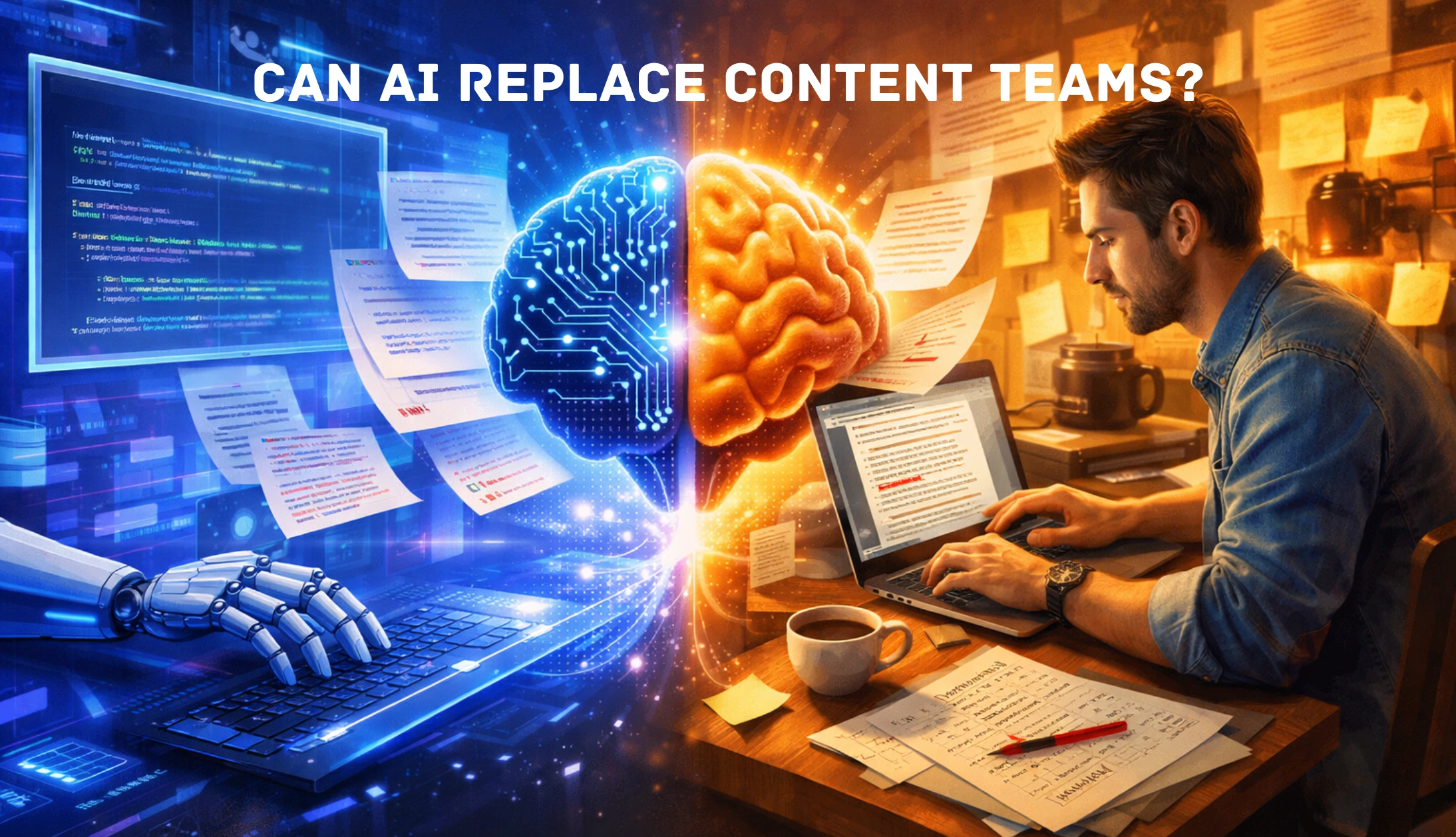
The Short Answer:
No. Generative AI cannot replace content teams, at least not the way many headlines suggest. What it can do is change how those teams work. According to a 2024 McKinsey report, 65% of organizations are now using AI in at least one business function, with marketing being among the top three. But using AI is very different from handing over the keys entirely.
The Rise of AI in Digital Marketing
It is hard to ignore what is happening. AI tools are everywhere in digital marketing right now. ChatGPT crossed 100 million users in just two months after launch, faster than any consumer application in history (Statista, 2023). Platforms like Jasper, Copy.ai, and Google Gemini are being built directly into marketing workflows.
AI powered digital marketing services are no longer a niche offering; they are becoming a baseline expectation. So the question is fair: if AI can write a blog post in 30 seconds, do you still need a team of writers?
What Generative AI Can Actually Do Well
Let’s be honest. AI is genuinely impressive at certain content tasks. Here is where it adds real value:
- Speed: AI can draft, summarize, and repurpose content in seconds
- Scale: It can produce hundreds of variations of ad copy without fatigue
- SEO basics: Keyword clustering, meta descriptions, and content briefs
- Research support: Summarizing long reports and pulling key data points quickly
A Salesforce study found that AI saves marketers an average of 5+ hours of work per week — which adds up to more than a full month per year. Adobe research puts content production time savings from AI at up to 60%.
AI vs. Human: Who Does What Better?
| Content Task | AI Performance | Human Performance |
| Drafting first copies | Excellent — fast and scalable | Good but slower |
| Brand voice and tone | Inconsistent | Strong and consistent |
| Emotional storytelling | Weak | Strong |
| Data accuracy | Risk of hallucination (~20%) | Reliable with research |
| Content strategy | Limited | Strong |
| Building audience trust | Cannot do it | Essential |
Where AI Falls Short in Content Marketing
Here is where things get real. Generative AI content marketing works best when a human is steering the ship. Without that oversight, the risks are significant.
Brand voice is the first casualty. AI does not know your audience the way your team does. It does not understand why your customers laugh at certain things or what keeps them loyal to your brand.
E-E-A-T is another major problem. Google’s quality guidelines emphasize Experience, Expertise, Authoritativeness, and Trustworthiness. Pure AI content often fails on the first two. It has no lived experience. It cannot cite a genuine case study from your business.
Then there is the hallucination issue. Stanford research found that AI language models produce confidently wrong information in roughly 20% of responses on knowledge-heavy queries. In content marketing, a single factual error can damage credibility significantly.
How Content Consumption Is Changing the Stakes
This is where many brands are missing the bigger picture. Your audience is not the same as it was five years ago.
Understanding how Gen Z consumes content today is critical for any content strategy. They spend over 4 hours a day on their phones, prefer short-form video and interactive formats, and have a sharp ability to detect inauthenticity. They are not impressed by polished corporate content — they want real voices, real opinions, and real stories.
AI cannot deliver that at scale without a human giving it direction and personality.
Meanwhile, the future of search is visual search. Google Lens processes over 12 billion visual searches per month (Google, 2023). Pinterest reports that 600 million visual searches happen on its platform every month. This means content teams need to think beyond text — and that requires creative human judgment that AI tools simply cannot lead.
The AEO Factor: Why This Changes Everything
Here is the irony that most people miss.
Why AEO matters is becoming one of the most important conversations in content marketing right now. Answer Engine Optimization is about structuring your content so that AI-powered search tools, like Google’s AI Overviews, Perplexity, and ChatGPT Search, can pull from it and surface it as a trusted answer.
But here is the catch: AI answers are built from human-authored, authoritative content. The better your original content, the more likely AI engines will cite and feature it.
So to win in an AI-first search world, you need more skilled human writers, not fewer. Cutting your content team to save money could ironically make you invisible in AI-generated search results.
What About AI Mode Ads?
Google’s AI mode ads are a newer development worth paying attention to. As Google rolls out AI-generated answer experiences in search, ads are being embedded directly into those AI responses, not just around them.
This changes the game for content and paid media teams alike. Your content now needs to work on two levels simultaneously: it must engage a human reader and be structured in a way that AI systems can interpret and pull from. That is a higher skill bar, not a lower one. If you want to know more about AI mode ads, explore our detailed blog on – AI mode ads.
The Hybrid Model: The Real Future
The data points in one direction. According to Salesforce, 51% of marketers are already using generative AI or experimenting with it, and another 22% plan to start soon. Yet only a tiny fraction says AI fully handles content without human involvement.
The winning model is not AI but humans. It is AI plus humans working smarter together.
The Human + AI Collaboration Model
| Content Task | AI Role | Human Role |
| First draft creation | Generates quickly at scale | Edits, refines, adds voice |
| Keyword research | Identifies patterns in data | Decides strategy and intent |
| Content briefs | Structures outline from prompts | Adds insight and direction |
| Visual content | Suggests formats and variations | Creates and art-directs |
| Audience strategy | Provides behavioral data | Interprets and applies it |
| Brand storytelling | Cannot lead authentically | Owns it fully |
Frequently Asked Questions
1. Will AI replace content writers?
Not entirely. AI will replace repetitive, low-skill writing tasks. Writers who bring strategy, voice, and expertise will remain in high demand.
2. Is AI-generated content bad for SEO?
Not automatically, but unedited, low-quality AI content can hurt rankings. Google’s guidelines focus on helpfulness and quality, not whether a human or machine wrote it.
3. Can AI handle content strategy?
No. Strategy requires understanding business goals, audience psychology, and competitive positioning. AI can support strategy with data, but it cannot own it.
4. What content jobs are most at risk?
High-volume, templated writing roles face the most disruption: product descriptions, basic ad copy, and formulaic social posts.
5. How should content teams adapt?
Learn to work with AI tools, focus on skills AI cannot replicate, strategy, storytelling, brand voice, and position yourself as the human layer that makes AI output usable.
Conclusion: Augmentation, Not Replacement
Generative AI is one of the most powerful tools to enter content marketing in decades. It saves time, scales production, and handles the heavy lifting of repetitive tasks. But it does not have opinions. It does not build relationships. It does not understand your brand the way your team does.
The smartest move any business can make right now is investing in AI services that combine the efficiency of technology with the creativity and judgment of skilled humans. That combination — not AI alone — is what will win in digital marketing over the next five years.
Your content team is not obsolete. It just has a very powerful new tool to work with.