The Google search page has changed. Did You Notice?
Not long ago, ranking on the first page of Google was enough. If your website showed up in the top five blue links, people clicked, visited, and converted. That was the game.
That game has changed.
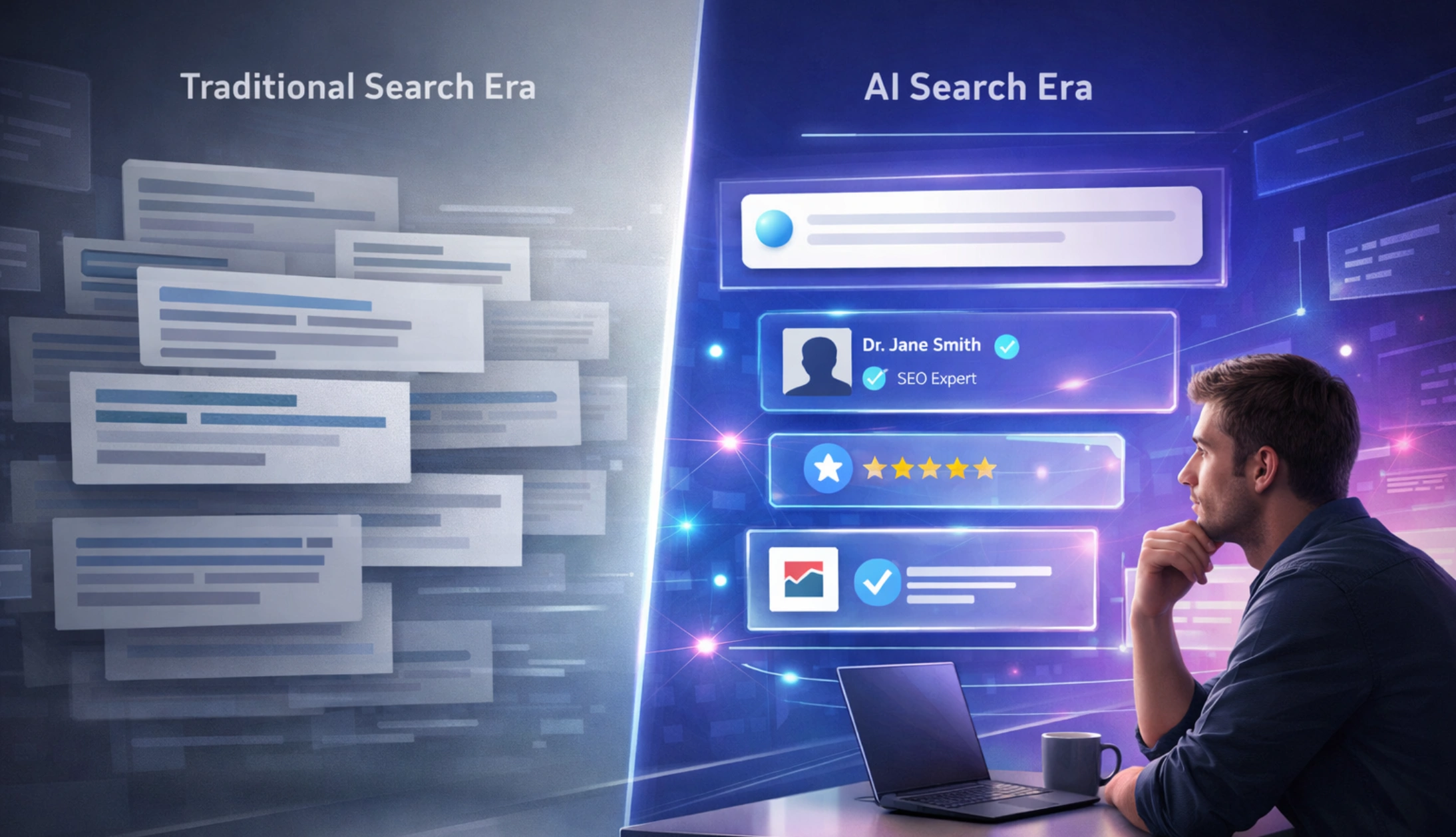
Google AI search results now appear at the very top of the page, before any links, before any ads. These AI overview search summaries pull from a small set of trusted sources, write a direct answer, and hand it to the user without them needing to click anywhere. According to Semrush data, AI Overviews now appear in about 16% of search queries globally, and the number is growing.
of all Google search queries, now trigger an AI Overview, and 80% of sources cited in those overviews don’t even rank in the top organic results.
Source: (Semrush, 2025)
Here’s the uncomfortable truth: even if your website ranks in positions one through three, you only have an 8% chance of being cited inside an AI Overview. Traditional SEO rankings are no longer the full picture.
So, what decides who gets cited? Authority signals. And if your digital marketing strategy isn’t actively building them, you’re becoming invisible to the platforms that now shape what people read, trust, and act on.
What Exactly Are Authority Signals?
Authority signals are the trust markers that AI systems and search engines use to decide whether your content is credible enough to show to users. Think of them as reputation cues, the things that tell an AI, “this source knows what it’s talking about and can be trusted.”
In traditional SEO, authority was mostly about backlinks. More links from bigger sites meant more authority. That still matters, but it’s no longer the whole story.
In generative AI search, authority is measured across a much wider range of signals, including your content depth, how consistently your brand appears across the web, whether real experts are behind your content, and how fresh and accurate your information is.
E-E-A-T Has a New Job Now:
Google’s E-E-A-T framework – Experience, Expertise, Authoritativeness, and Trustworthiness- has always been important for SEO. But in the era of AI overview search and generative AI search, it’s been promoted. It’s now the core filter AI systems use to decide which sources get quoted in their answers.
The difference today is that AI doesn’t just check if a page looks credible. It cross-references your brand identity across the entire web, your website, your social profiles, third-party mentions, review platforms, and more. If those signals are consistent and strong, you get cited. If they’re weak or scattered, you get skipped.
Think of it this way: Generative AI search doesn’t just read your website. It checks your reputation across the whole internet before deciding whether to quote you.
How Generative AI Search Actually Decides What to Show
When someone types a question into Google today, something very different happens compared to just two years ago. Instead of fetching ten links, Google’s AI reads across dozens of pages simultaneously, synthesizes the key points, and presents one clean answer, with a handful of cited sources underneath.
This process is called generative AI search, and it’s fundamentally different from traditional ranking. The AI isn’t just looking at which page has the most backlinks. It’s looking for pages that are clearly structured, factually accurate, consistently updated, and written by credible humans.
A Real-World Example of Generative Search in Action
Let’s say someone searches: “What are the best AI digital marketing services for small businesses in 2025?”
The AI Overview result won’t list ten websites. It will give a direct paragraph answer — something like: “The top AI digital marketing services for small businesses in 2025 include tools for content creation, social media scheduling, ad optimization, and email personalization.
Here is what it looks like:
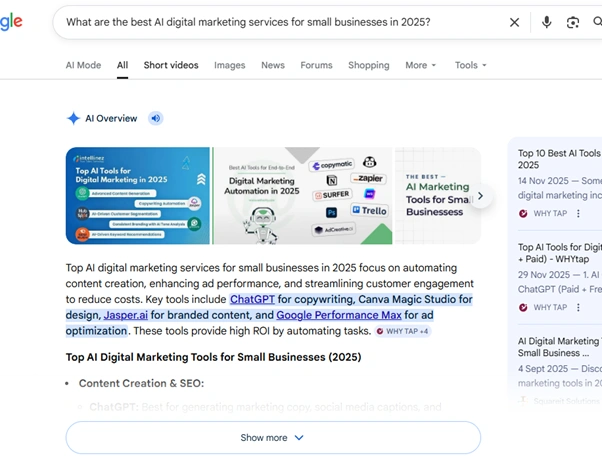
The brands that get mentioned in that paragraph aren’t necessarily the ones with the highest domain authority. They’re the ones whose content is clear, current, and backed by consistent trust signals across the web. That’s the shift.
What Google AI Overview Search Actually Looks For:
Based on the latest research into how AI overview search citations work, here are the factors that matter most:
- Content depth: AI rewards comprehensive coverage of a topic, not surface-level posts.
- Clear authorship: Named authors with real credentials signal expertise.
- Consistent entity signals: Your brand name, description, and information should match everywhere it appears online.
- Third-party mentions: Brands cited by other reputable sources are far more likely to be cited by AI. In fact, brands are 6.5x more likely to be cited through third-party sources than from their own domain.
- Structured content: Proper use of headings, FAQ schema, and logical page structure makes content far easier for AI to read and cite.
The 5 Authority Signals That Matter Most Right Now
Here’s a clear breakdown of the five signals AI systems use most, what each one means, why it matters, and what action to take:
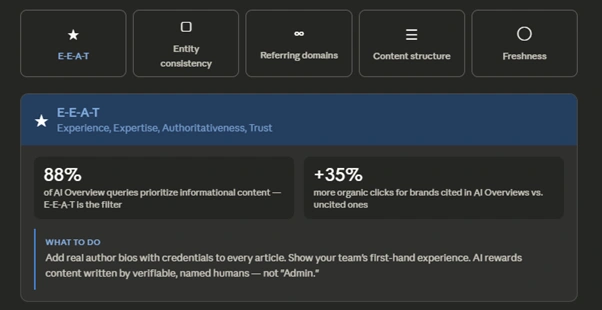
| E-E-A-T | Experience, Expertise, Authoritativeness, Trust | 88% of AI Overviews target informational queries — credibility filters determine who gets cited | Add named author bios with real credentials to every page |
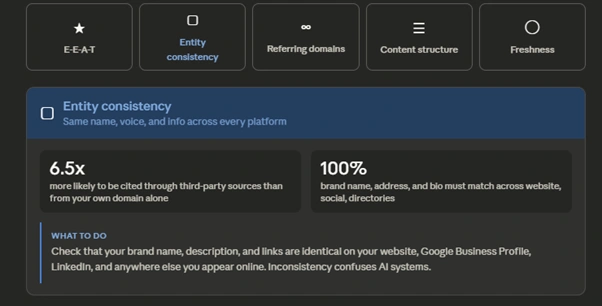
| Entity consistency | Identical brand info across all platforms and directories | AI cross-references your brand across the entire web to verify identity | Audit your name, bio, and links across all channels — make them identical |
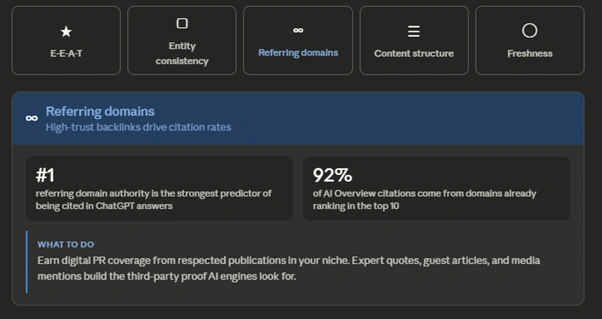
| Referring domains | High-trust third-party sites linking to or mentioning you | Brands are 6.5x more likely to be cited via third-party sources than their own domain | Pitch expert quotes and guest articles to respected publications in your niche |
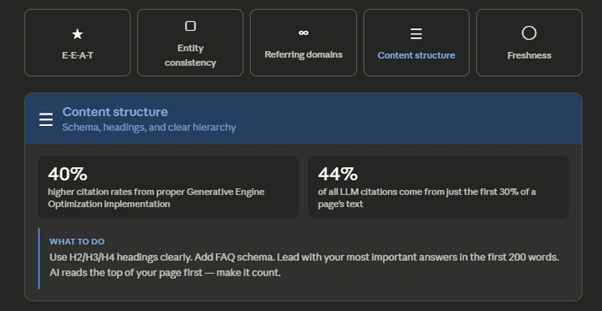
| Content structure | Headings, schema markup, and clear logical hierarchy | 44% of all LLM citations come from just the first 30% of a page — structure is everything | Use H2/H3/H4 headings clearly. Lead with your best answer in the first 200 words |
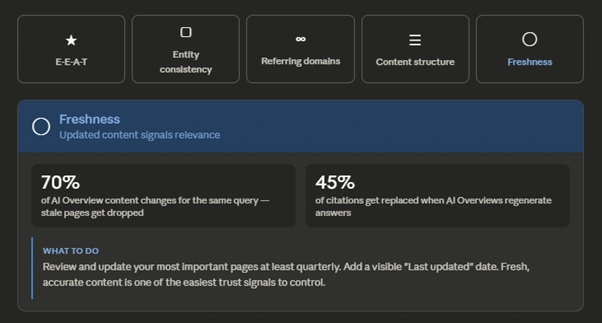
| Freshness | Regularly updated content with visible dates | 70% of AI Overview content changes for repeated queries — stale pages get dropped fast | Review and refresh key pages at least quarterly. Add a visible “Last updated” date |
Notice something about that table? None of those signals are shortcuts or hacks. They’re all about genuinely being credible, and making that credibility visible and verifiable. That’s what makes authority signals so different from old SEO tricks. You can’t fake them at scale. But you can build them deliberately.
How Digital Marketing Needs to Shift Right Now
This isn’t a warning for the distant future. The shift is already happening, and digital marketing teams that are still focused only on traditional keyword rankings are already losing ground to those who have adapted.
The good news is that adapting doesn’t mean throwing out everything you’re doing. It means extending your strategy to include the signals AI systems actually look for.
AI Digital Marketing Services Are Leading the Change:
The rise of AI digital marketing services isn’t just about automating tasks. The best ones are now built around helping brands build genuine authority, identifying content gaps, improving topical depth, ensuring consistent entity signals, and tracking citation performance across AI platforms.
If you’re evaluating AI digital marketing services for your business, look for ones that specifically mention Generative Engine Optimization (GEO), AI citation tracking, and E-E-A-T auditing. These are the markers of services that understand where search is actually going.
One real example worth noting: NerdWallet saw a 20% drop in traditional website traffic in 2024, but achieved 35% revenue growth by doubling down on AI search optimization. The traffic metric changed; the authority signal strategy paid off.
AI in Social Media Marketing Counts Too:
Here’s something many brands miss: AI in social media marketing isn’t just about scheduling posts or generating captions. Your social media presence is now an authority signal in itself.
AI systems aggregate signals from across the web, and that includes social platforms. A brand with a consistent, active, and credible presence on LinkedIn, YouTube, or other platforms gets cross-referenced by AI when it’s deciding whether to cite that brand in a search result.
Unlinked brand mentions on social media also count. Even when someone mentions your brand without a link, repeated contextually relevant mentions help AI systems recognize and categorize who you are and what you’re an authority on.
Strategies for Instagram Reach in the AI Search Age:
Instagram specifically has become more relevant to AI authority than most brands realize. Here’s why: Instagram content and brand mentions feed into a broader AI understanding of your entity. Strategies for Instagram reach that build authority include:
- Publishing consistent, expert content: Niche-specific posts that show genuine knowledge, not just promotional graphics, build topical credibility over time.
- Collaborating with recognized voices: Collaborations and features by other credible accounts build cross-platform authority that AI systems can detect.
- Maintaining brand consistency: Your Instagram bio, name, and website link should perfectly match every other platform where you exist. Entity consistency includes social media.
- Creating content that gets referenced: When your Instagram posts, Reels, or carousels are cited or referenced by other accounts, that’s a third-party signal — the kind AI systems reward most.
Content Optimization Tools That Help
Building authority manually across dozens of platforms and content pieces is hard work. Thankfully, content optimization tools have evolved to help teams do this at scale.
The most useful content optimization tools for the generative search era do three things: they audit your existing content for structural and authority gaps, they track whether your content is appearing in AI-generated answers, and they help you maintain freshness and consistency across your content library.
When evaluating any content optimization tools, look for ones that include AI citation monitoring, schema validation, E-E-A-T scoring, and topical authority mapping. These features are the difference between tools built for the old search world and ones built for the one you’re actually in.
A quick benchmark: Research shows that proper Generative Engine Optimization (GEO) implementation can increase your citation rates in AI platforms by up to 40%. That’s not a minor improvement, it’s the difference between being part of the conversation and being invisible to it.
What You Should Start Doing Today
You don’t need to overhaul everything overnight. But there are a few high-impact changes you can start immediately:
- Audit your author attribution. Go through your key content pages. Are there real, named authors with bios and credentials? If not, that’s your first fix.
- Check your entity consistency. Search your brand name across Google, your social profiles, and any directory listings. Are the name, description, and website link identical everywhere? Fix any inconsistencies.
- Lead with your answer. For your most important pages, make sure the core question is answered clearly in the first 200 words. AI systems cite the top of the page most.
- Add or update schema markup. The FAQ schema in particular increases your chances of being featured in AI-generated Q&A results. Use Google’s Rich Results Test to check what you’re missing.
- Start tracking AI visibility. Not just Google rankings — monitor whether your brand is being cited in AI Overviews and other generative AI search tools. This is the new metric that matters.
The Bottom Line:
Search has always rewarded the most credible sources. What’s changed is that AI now does that evaluation faster, more comprehensively, and less charitably to brands that rely on old tactics.
Google AI search results don’t just pick the page with the most backlinks. They pick the source that looks most like a genuine authority, consistent, current, clearly authored, and well-structured. That’s what authority signals are, and that’s why they matter more now than at any point in digital marketing history.
If your strategy is still built around ranking in the blue links, it’s time to expand it. Build the signals that AI systems trust. Show up the way generative AI search expects you to. And start thinking less about getting clicks, and more about being the answer.