Quick answer:
Zero-click search happens when Google answers a query directly on the SERP through AI Overviews, featured snippets, or knowledge panels, so users never visit your site. To build brand visibility without clicks: optimize for featured snippets, implement schema markup, build topical authority, and track SERP impression share instead of traffic volume alone.
You ranked. You-wrote the content. You did everything right. And still, nobody clicked. That is not a failure. That is zero-click search in action. It is now the dominant reality of Google, and it is reshaping how brand visibility works at every level.
The real question is not whether this is happening. It clearly is. The question is: can your brand still win when the click never comes? Yes. But it requires a different playbook and help from AI powered digital marketing services.
What is Zero-Click Search, and Why Should You Care Right Now?
1. The Simple Definition
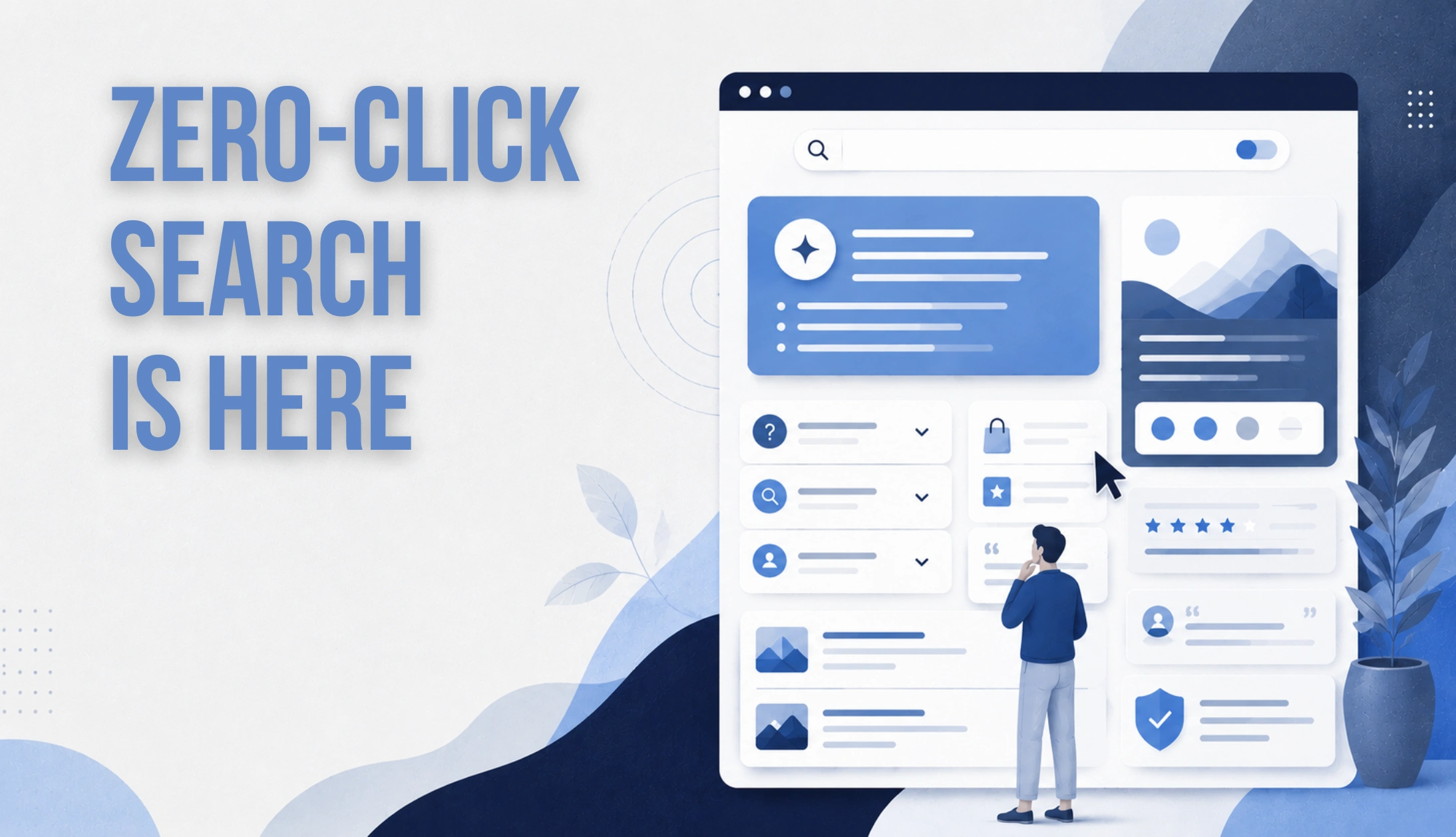
A zero-click search happens when a user types a query into Google and gets the answer right there on the results page. No click needed. No website visited.
These answers are delivered through AI Overviews, featured snippets, knowledge panels, People Also Ask boxes, and direct answer modules. The SERP is no longer a gateway. It is the destination.
2. The Numbers Behind the Shift
This is not a small or gradual trend. The data makes the scale impossible to ignore.
- 58.5% of US Google searches and 59.7% of EU searches end without a click to any external website, per Semrush’s 2025 data.
- When AI Overviews are triggered, that zero-click rate climbs to 80 to 83%.
- Organic CTR for queries featuring AI Overviews dropped 61% since mid-2024, according to SearchEngineLand.
- On mobile, over 77% of searches now result in zero clicks.
3. What This Actually Means for Your Brand
Most brands treat this as a traffic problem. It is actually a measurement problem. Your content can be seen by thousands of searchers on the SERP without generating a single click. If you are only tracking sessions and CTR, you are counting less than half the picture. The next section explains how to fix that thinking.
The Shift You Need to Make: From Traffic Thinking to Visibility Thinking
Why Clicks No Longer Tell the Full Story
Traffic volume was a reliable proxy for brand reach when every searcher had to visit your site to get information. That world no longer exists.
Today, a searcher can read your brand name, absorb your answer, and form a trusting opinion about you, all without ever leaving Google. If your analytics only count the visitors who clicked, you are invisible to that entire layer of brand influence.
SERP Impression Share Is Your New Top-of-Funnel Metric
Impression share measures how often your content appears across SERP features for your target keywords. It is now the primary signal for top-of-funnel brand reach.
Think of it this way. A featured snippet appearance is a billboard on the busiest road in your industry. You do not have to own the road to get seen. You just have to be on the billboard. This is the core idea behind AI answer engine optimization, and it is where forward-thinking brands are already putting their energy.
Visibility Builds Trust Even Without a Click
Research consistently shows that brands cited in AI Overviews receive more organic clicks downstream than brands that are not cited at all. SERP presence is a trust signal.
Users see your brand recommended by Google’s AI. They search your name later. They-visit directly. They buy. The zero-click impression is not the end of the journey. It is often where that journey begins. With that mindset in place, here is exactly how to build that presence.
5 Practical Ways to Build Brand Visibility in a Zero-Click World
1. Win Featured Snippets With Answer-First Content
Featured snippets sit above all organic results. They go to whoever answers a question most clearly. The good news is that the formula is predictable.
Structure each content section like this:
- Use a question as your H2 heading (What is, How to, Why does).
- Follow the heading immediately with a direct 40 to 60-word answer.
- Expand with supporting detail, examples, or a table below the answer block.
- Target queries that start with what, how, why, and best.
This same structure is what AI platforms like ChatGPT and Perplexity extract when building their responses. Understanding how authority signals in AI search work helps you structure content that performs across both Google and AI answer engines.
2. Optimize for People Also Ask (PAA) Boxes
PAA boxes are one of the most overlooked visibility opportunities on the SERP. Every PAA question is free audience research. Google is telling you exactly what follow-up questions your readers have.
How to use PAA for visibility:
- Collect PAA questions for your target keywords using Ahrefs or SEMrush.
- Turn each relevant question into an H3 subheading in your content.
- Answer each one in 40 to 60 words directly beneath the heading.
- This sets you up to win both the PAA box and the featured snippet for that question.
One well-structured page can appear multiple times across a single SERP through PAA expansion. That is compounding zero-click visibility from a single piece of content.
3. Implement Schema Markup
Schema markup is the technical signal that tells search engines what your content means, not just what it says. It directly increases your eligibility for rich results and AI citations.
Priority schema types to implement:
- Surfaces your Q&A content directly in search results. (FAQPage Schema)
- Structures step-by-step instructional content for rich results. (HowTo Schema)
- Boosts eligibility for AI Overview citations. (Article Schema)
- Enhances visibility in local knowledge panels and map results. (LocalBusiness Schema)
Validate your markup with Google’s Rich Results Test. Pair this technical foundation with a full answer engine optimization strategy to see compounding gains across both traditional SERP features and AI search platforms.
4. Build Topical Authority Around Your Brand’s Core Topics
Brands that dominate zero-click real estate are not winning on individual pages. They are winning through content depth and interconnection.
The pillar-cluster model is how topical authority is built:
- Create a broad pillar page that covers a core topic comprehensively.
- Build cluster pages that go deep on each subtopic and link back to the pillar.
- Keep internal linking tight and contextual throughout the cluster.
- Update content regularly. AI engines favor freshness and recency.
Brands with dense, well-connected content on a topic get cited in AI Overviews repeatedly. Those without it rarely appear. This content library is a long-term brand asset that compounds over time.
5. Diversify Across AI Search Platforms, Not Just Google
Google is no longer the only discovery platform that shapes brand perception. ChatGPT, Perplexity, and voice assistants are now part of the buying journey for a growing share of your audience.
How to expand your multi-platform presence:
Use the right tools to scale content production without burning out your team. This list of the top 5 AI tools for different tasks covers what content and visibility teams are actually using right now to stay ahead across platforms.
Consistency across social channels also compounds brand recognition over time. A reliable social media scheduling tool stack keeps your content active and on schedule, so your brand stays visible even while your SEO strategy handles the heavier lifting.
Brands that appear across Google, AI answer engines, and social channels build recall that no single platform can deliver on its own.
What Does Success Look Like Without Clicks?
– Ditch Traffic Volume as Your Only KPI
If your monthly report leads with sessions and organic traffic, you are measuring an incomplete picture. A decline in clicks does not always signal a decline in brand performance. It may mean your brand is becoming more visible on the SERP itself.
Reframe the goal. You are not just trying to drive visitors. You are trying to build the brand that searchers recognize, trust, and eventually come back to.
– The KPIs That Actually Reflect Zero-Click Performance
Here is what to track instead, alongside where to find the data.
| KPI to Track | What It Tells You | Where to Find It |
|---|---|---|
| SERP Impressions | Your brand’s on-SERP reach | Google Search Console |
| Branded Search Volume | Growing name recognition | GSC + Google Trends |
| AI Overview Citations | Authority in AI-generated results | Semrush / Ahrefs / Manual |
| PAA Appearances | Topical relevance signals | Ahrefs SERP Feature Report |
| SERP Feature Share of Voice | Competitive visibility standing | Semrush Position Tracking |
KEY INSIGHT:
High impressions with low CTR are not a failure. It is a signal that your brand is gaining SERP presence. That presence drives branded searches, direct visits, and eventual conversions that last-click attribution will never capture.
The One Mindset Trap to Avoid
Not All Content Should Chase Snippets:
Optimizing everything for featured snippets and AI Overviews is a mistake. Zero-click rates are highest on informational queries. But not every page should be an informational page.
Transactional queries, where a user is ready to buy, compare, or contact a business, still drive strong click-through rates. Chasing snippets on those pages can actually hurt your conversion potential by pulling users away before they act.
How to Balance Your Content Mix:
A healthy content strategy in 2026 separates these two goals clearly:
- Optimize for AEO, snippets, and PAA. The goal is SERP visibility and brand awareness. For this, informational content:
- Optimize for clicks and conversions. The goal is getting the user to your page and converting them. It’s transactional content:
- Can do both. Target mid-funnel searchers who need to decide. Drive the click. This type of content is comparison content:
Beyond search, building recognition in the spaces where traditional SEO cannot reach is just as important. Learning how to boost your brand with vibe marketing gives you a complementary layer of presence across social communities and cultural conversations where intent is shaped before anyone opens a search bar.
Frequently Asked Questions About Zero-Click Search
1. Does Zero-Click Search Mean SEO Is Dead?
No. Zero-click search does not kill SEO. Rankings still matter, especially for commercial-intent queries. What changes is how you measure success. Visibility and brand impressions now sit alongside clicks and sessions as core performance indicators.
2. How Do I Know If My Content Is Appearing in AI Overviews?
Use Google Search Console to monitor impressions for your target queries. You can also search priority keywords manually and scan for AI Overview citations. Tools like Semrush and Ahrefs offer SERP feature tracking that flags AI Overview appearances alongside traditional rankings.
3. Is Zero-Click Search the Same as AEO?
They are related but different. Zero-click search is the behavior that happens when Google answers a query on the SERP. AEO, or Answer Engine Optimization, is the strategy you apply so your content is the one Google chooses to surface as that answer.
4. How Long Does It Take to See Results From Featured Snippet Optimization?
Brands that apply answer-first formatting and proper schema markup consistently often see snippet appearances within 4 to 12 weeks for lower-competition queries. High-competition queries take longer and require stronger topical authority across a content cluster before results appear.
Start Here This Week For Better Visibility
Your First Action Step:
Zero-click search is not the end of visibility. It is a redefinition of what visibility means. The brands building real search presence right now are not fighting the SERP. They are showing up inside it, consistently, across AI Overviews, featured snippets, PAA boxes, and knowledge panels.
Start this week with one concrete audit:
- Open Google Search Console and pull your top 20 queries by impressions.ind the queries with high impressions but low CTR.
- Those are your first featured snippet targets. Structure an answer-first section for each one.
- Add FAQPage schema to every page you update.