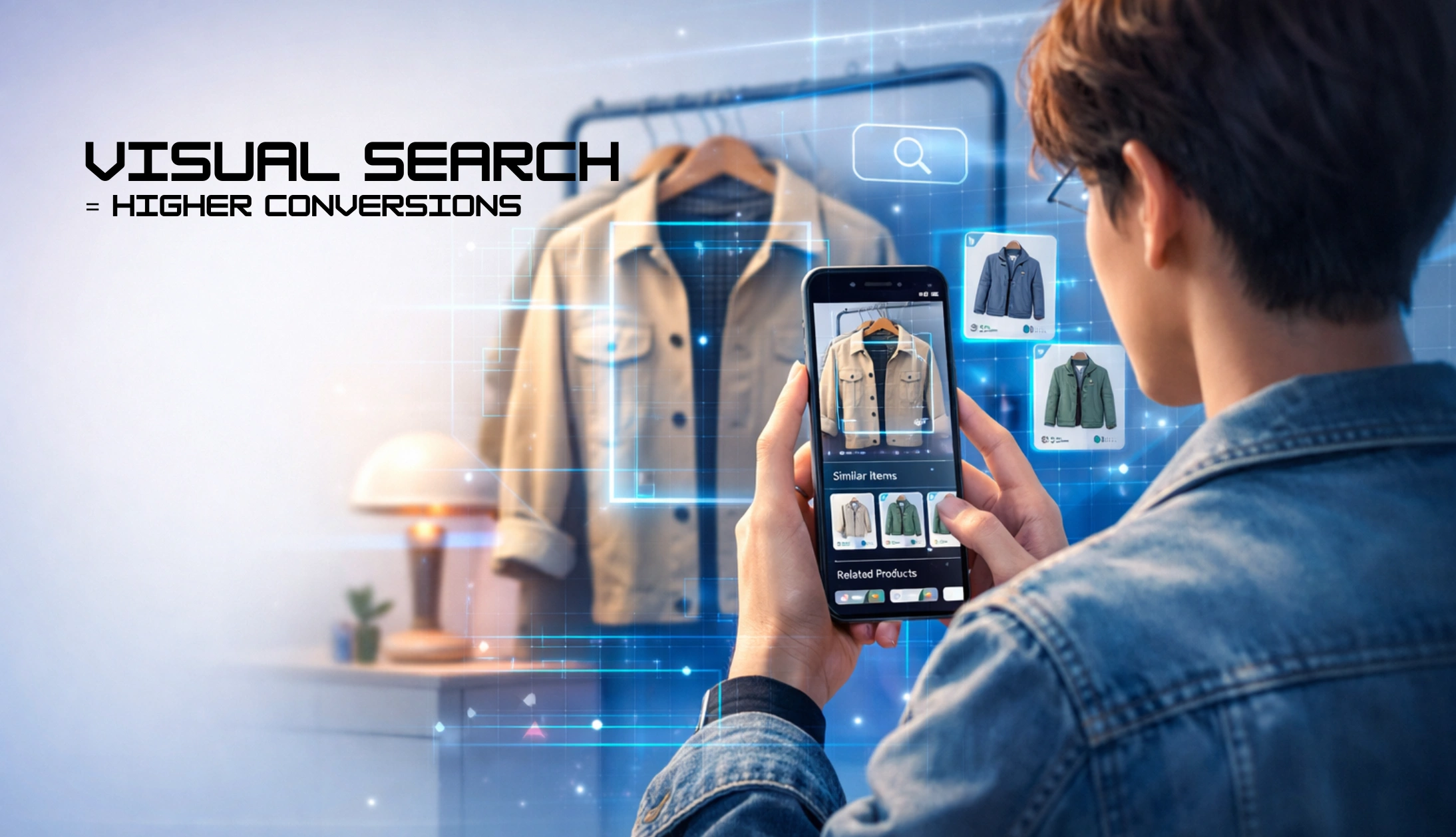
Your next customer must just be searching with a camera, but are you ready? Imagine walking past someone wearing a cool jacket and instantly finding out where to buy it, just by taking a photo. Or spotting a weird-looking plant and learning its name in seconds. That’s visual search!
Traditional search works well when you know what to type. But what if you don’t have the right words? Describing a unique style, a rare object, or an unfamiliar item can be tricky. That’s where visual search comes in.
Powered by AI, it lets you search using images instead of text. And in this blog, we will show you how it works, why it matters, and how businesses can make their images ‘searchable’ to stay ahead in the digital marketing game.

What is Visual Search? The Layperson’s Guide
Visual search is like asking online a question, but instead of typing words, you upload a picture by taking a photo with your phone or a screenshot you grab online. It helps in finding products, places, and information just by using an image.
For example, let’s say you spot a cool night lamp in a café. You can take a picture and search it in tools like Google Lens, Pinterest Lens, and Amazon’s Image search. They instantly show you similar lamps to buy.
💡The global visual search market is expected to reach $151.60 billion by 2032 with a growth rate of 17.50% [source: DataBridge].
How Does Visual Search Work? It works using AI and image recognition, which means the tech can ‘see’ what’s in your photo and match it to real products or info online. From pixels to profits, it’s time to optimize your photos today!
What Are Common Tools Leading The Visual Search Revolution?
Visual search tools are already built into the apps for shopping or exploring, making it easy to search with a photo instead of words. Here are the top players:
1. Google Lens:
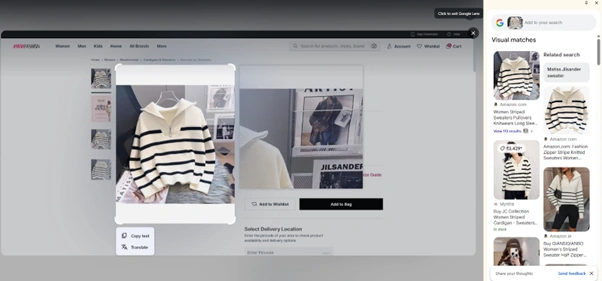
These are built into Android phones, Google Photos, and Chrome browsers. How to use? Point your camera or upload a photo [figure 2], and Google Lens will-
- Identify the product, animal, plant, or landmark.
- Copy text from images (signs or menus).
- Solve math problems.
- Translate languages.
It is great for shopping as you can take a picture and instantly find where to buy it. Most Google Lens results come from mobile-friendly websites, making it super smooth for phone users. So, make sure your website is mobile-ready!
💡 Google Lens is used for nearly 20 billion visual searches every month, and about 20% of all Google Lens searches are related to shopping [source: Google].
2. Pinterest Lens:
It’s a built-in feature on the Pinterest app that’s perfect for discovering fashion, home décor, and lifestyle ideas. The user can snap or upload a photo to find similar pins, styles, or products.
In fact, it is a favorite for trend spotting, DIY inspiration, and visual mood boards. Whether redecorating your room or planning an outfit, Pinterest Lens helps you find what matches your mood & vibe.
💡 In a recent study, it was found that 73% of respondents use Pinterest visual search over traditional search, and 36% of them now use Pinterest for searching instead of traditional platforms like Google [source: Pinterest].
3. Amazon Lens:
Integrated into the Amazon shopping app, it helps users snap a photo or upload it to instantly get a list of similar products. It is best for price comparisons, quick buying decisions, and skipping the guesswork of typing in keywords.
If you are at a store or browsing online, Amazon Lens can help you go from ‘I like that’ to ‘I found it’ in seconds.
💡 Amazon has seen a 70% year-over-year increase in visual searches worldwide, as customers use these new features [source: Amazon].
Why Visual Search is Booming?
Visual search is taking off because it is faster, easier, and feels natural, especially for mobile users. Instead of typing ‘white sneakers with a red stripe and chunky sole’, you just take a photo and get an instant result. No guessing, no clunky descriptions.
About 62% of Gen Z and Millennials prefer visual search over text [source: PageOn]. This highlights the importance of using high-quality images on your website. Shoppers love it because:
- They can compare prices across stores without visiting them individually.
- They can find styles they have seen in real life.
- They can locate products without knowing the brand name.
Tip: Brands that use images get discovered more often through tools like Google Lens.
How To Make Your Image ‘Searchable’ Online?
Here are 5 ways you, as a business, can make your products discoverable online:
- Using Clear, High-Quality Images – Avoid using blurry or cluttered photos, and when taking pictures for your website, try using natural lighting and clean backgrounds.
- Add Alt Text – Alt text is a short description of the image that helps Google to understand what’s in the photo. So, write clearly to get listed in visual image searches. For example, you can write ‘Boho chic, knee-length black dress with eyelets’.
- Rename Your Image Files – Don’t just type random words or numbers into the image file. Instead, use keyword-rich filenames. For example, instead of writing ‘img_1678.webp’, opt for ‘crew_neck_sweatshirt_white.webp’
- Use Structured Data – Add schema markup to the product pages, which helps search engines connect images with the product information.
- Make Your Site Mobile-Friendly – Google Lens favors mobile-optimized websites, so choose a fast-loading, responsive design for better visibility.
A Quick Comparison Between Visual Search Vs. Traditional SEO
| Features | Visual Search | Traditional SEO |
| Input Type | Image | Text/ Keywords |
| Speed | Instant | Depends on the query |
| Discovery | – Style-based – Intuitive | Intent-based |
| Optimization Focus | – Image Quality – Alt text | – Keywords – Backlinks |
| Best For | – Shopping – Design – Lifestyle | – Research – Info – Services |
How Can Businesses Benefit From Visual Search Optimization?
By optimizing content for visual searches, a business can get –
- More traffic, especially from mobile users
- Higher engagement and conversion rates
- Better visibility on Google Shopping, Pinterest, and Amazon
- Complete visually with big retailers
Soon, visual searches will be used for things like home repairs, travel, and education. When combined with augmented reality (AR), it gives a seamless experience to users. Imagine pointing at a blank wall and seeing what a painting would look like there or scanning a furniture to see if it fits in your room.
Snap Into Visibility, Visual Search Starts Here
Snap, search, and sell! That’s not just a cool tech trend but a major shift in how people shop and find things online. For shoppers, it’s faster and easier as they don’t need to guess the right keywords. Just snap a photo and get instant results.
For businesses, it’s a golden opportunity to reach customers who are searching with their cameras and not keyboards. The one who adopts early will stand out in a crowded market by making their product visually searchable.
So, now is the time to think beyond text because in today’s world, a picture really is worth a thousand keywords.