Competition among brands is rising, so confusion is also. It is about choosing the best digital marketing strategy in 2025. Brands are struggling to choose between traditional SEO and performance marketing due to the changed landscape following the advent of generative AI. With AI tools reshaping search behavior, consumer expectations rising, and businesses demanding quick results, it’s no longer a matter of just ranking higher on Google. It’s about what actually drives results.
This is why they are chasing one big question: “Should I do SEO or PPC?”. Both Traditional SEO and Performance Marketing offer unique advantages. One builds long-term credibility. The other delivers fast, measurable returns. But which strategy wins in 2025? We will break it down and help you choose what works best for your business.
Quick Overview: Traditional SEO and Performance Marketing
Understanding the core meanings of both strategies will help you effectively grasp the difference between them. Well, the core difference begins with the definitions, making it easy to decide which one to choose.
What is Traditional SEO?
Traditional SEO is all about ranking a website in Google SERPs. When a website ranks, it becomes more likely to receive clicks from potential users. Because 91.5% people only click on pages ranking at 1, 2, 3. They hardly scroll down to check other pages. So, SEO is all about making your website more visible on search engines like Google or Bing, without paying for every click.
SEO marketing focuses on:
- Creating high-quality, helpful content
- Using the right keywords
- Improving website speed and user experience
- Earning backlinks from other trusted websites
Think of SEO like building a house; it takes months, but once it’s built, you don’t have to rebuild every week. Well, SEO is not done only for ranking in Google and Bing search engine results, but also on YouTube search result pages. For this, you must know how to rank your videos on YouTube? Its ranking strategies differ slightly, as they are specific to video marketing.
What is Performance Marketing?
As the name implies, it is a result-driven digital marketing strategy. You, as a business owner, only have to pay when specific actions happen, like clicks, leads, or sales. So, it is based on the performance of the marketing campaign. Brands use it for immediate and measurable results.
Performance marketing focuses on:
- Paid search ads (Google Ads)
- Social media ads (Facebook, Instagram, LinkedIn)
- Affiliate marketing
- Influencer campaigns tied to ROI
It’s called “performance” marketing because you are tracking the performance of every campaign. If an ad doesn’t perform, you tweak, pause, or stop it immediately. However, brands are increasing their ad spends more than ever, it is because of growing competition in digital advertising. Have a look at the statistics below.
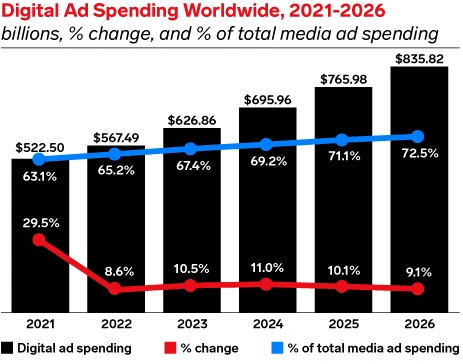
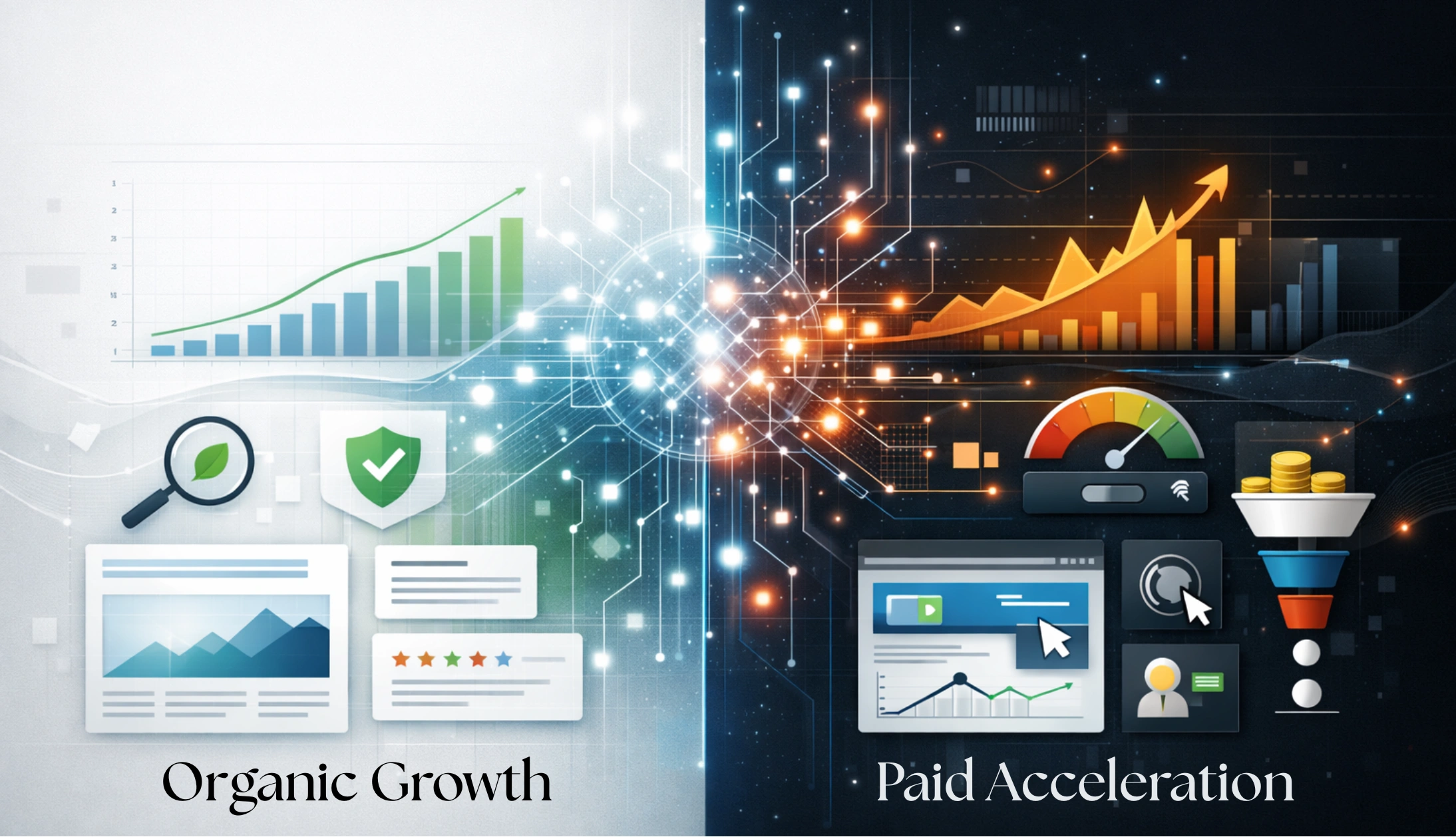
Long story short: SEO is for organic traffic, and performance marketing is for showing ads for traffic.
Comparison Between Traditional SEO and Performance Marketing
Both are marketing strategies, but they are practiced differently. The time to deliver the result also differs. There are many things that differ between them. Choosing the best is crucial to beating competitors in 2025.
1. Do You Need Results Soon?
Often, companies need quick results. SEO marketing takes time to deliver results because it’s a process. Whereas performance marketing doesn’t take that long. It provides fast results. For example, if you want to increase traffic in a month, run more ads based on the behaviors of your audience on the platforms where they spend time. If you work with a firm where founders, CMOs, and stakeholders all want to see traffic, leads, and sales fast. Performance marketing can meet your requirements.
Traditional SEO:
- Slow process, takes 3–6 months or more to see strong traffic
- But delivers sustainable, compounding growth over time
Performance Marketing:
- Instant results, ads go live, traffic comes in
- Stops the moment ad spend is paused
2. Will This Investment Pay Off Long-Term?
If SEO is applied strategically, it generates free traffic for months. Sometimes, paid marketing or PPC may be less effective because people find ads irritating, and thus, they do not click on ads. When something comes to them naturally, they are more likely to click on it. Studies show that organic search drives over 53% of all web traffic (BrightEdge, 2023). But in PPC, ongoing investment is needed to drive results. It is a costly digital marketing method for many startups and small businesses.
Traditional SEO:
- Once content ranks, it generates free traffic
- No Need for frequent investment
Performance Marketing:
- ROI depends on constant ad spend
- More costly than traditional SEO
3. Do People Actually Trust Your Brand?
If you want your audience to trust your brand, it will take time because it’s a process. SEO helps you build trust more effectively. This is not only about visibility. Today’s users are skeptical; they view ads with doubt, making it challenging to create trust through paid marketing. If you are new to the market and not in a hurry to generate profits, proceed slowly but steadily with traditional SEO. You can follow top SEO trends in 2025 to stay ahead of the curve. When people find your content naturally everywhere, they are more likely to trust your brand. Because being seen is one thing and being trusted is another.
Traditional SEO:
- Create higher trust among users
- Users often trust organic results more than ads.
Performance Marketing:
- Lower perceived trust
- Some users skip ads altogether
Can We Grow Without Burning the Budget?
Having a long-term growth plan for your brand brings lasting benefits. Once you have built solid visibility and trust, your brand starts attracting organic traffic, then no need to pour money into paid ads. This way, people start recognizing your brand for specific products or services, so they come directly to you instead of exploring competitors. Traditional SEO makes it all possible.
It delivers steady reach and visibility without ongoing high costs. On the other hand, performance marketing demands consistent funding; the moment the budget stops, so does the traffic. While it brings faster results, it may not be as sustainable for long-term brand growth without a solid financial plan.
5. Can We Pivot When Things Change?
In Performance Marketing, pivoting is quicker. You can change ad creatives, target audience, or platforms almost instantly. If something’s not working, you can test and tweak in real-time. That’s a big plus for fast-moving markets. Traditional SEO, however, takes more time. Keyword strategies, content updates, and backlink shifts don’t show results overnight.
So, pivoting in SEO means adjusting long-term content plans, site structure, or optimization tactics, and that requires patience. Therefore, if your brand requires rapid adjustments, performance marketing provides greater flexibility. But if you need sustainable growth in 2025, SEO provides a stable foundation, even if changes take time.
A Quick Comparison Table
| Features | Traditional SEO | Performance Marketing |
| Cost | Low ongoing expense | Pay as you go |
| Timeline | 6-12 months for ROI | Immediate results |
| Conversion Rate | 14.6% | Varies but around 200% ROI |
| AI Readiness | Needs update. Currently AEO, GEO, technical SEO | Ads can be adjusted with the help of AI tools |
How to Decide on The Best Marketing Methods?
It all starts with your goals. Don’t make long-term goals because they confuse you. Start from a small level; make small goals. Once you are clear about what you want and how soon, you can easily decide on a digital marketing strategy. You have read about the situations above, where it is clear which marketing strategy works best. Now, scroll down to learn some statistics because they also help in making the right decision.
PPC offers $2 back for every $1 spent, a 200% ROI. However, choose the right keywords and bid for them after thorough analysis. Paid search accounts for 40.9% of all global digital ad spending. On the other hand, SEO provides long-term value. Its conversion rates reach 14.6%, compared to 1.7% for traditional outbound channels. Moreover, 57% of B2B marketers see SEO as their most effective channel.
Also, consider the following points to choose the best method for your business marketing.
- Set your business goals; that’s exactly what you want to achieve. Do you want leads/sales/conversions? Based on goals, you can not only choose the right strategy but also use it correctly.
- Always set a budget, as overspending can negatively impact your business growth. Since you know that SEO provides organic growth, start with it and gradually transition to PPC.
- Be sure about how fast you want results. Can you wait for more than 3 months, or do you want immediate results? If you need results in weeks, performance marketing will be the best digital marketing strategy. Or have months to grow steadily, go for SEO.
- Do not forget to evaluate your team’s skills because, ultimately, your digital marketing team is going to work, not you directly.
- Last but not least, do not forget to analyze your industry competition. If you notice high competition in paid ads, SEO can be an effective way for you. Or if, organic space is saturated, paid ads can get you noticed fast.
How AI Is a Game Changer in Digital Marketing?
Without understanding the impact of AI on digital marketing, it can be challenging to select an effective digital marketing strategy.
After the introduction of ChatGPT, many other generative AI tools bombarded in market. They significantly impact the marketing landscape and the digital marketing trends 2025. It led to a “zero-click” trend, which means 80% of users complete 40% of searches without clicking. This evolution means brands must restructure content to appear in AI-generated answers, not just traditional SERPs.
Moreover, marketing through videos has also changed, or is set to change significantly, following Google’s new launch, Veo 3. According to research, nearly 40% of video ads are expected to utilize GenAI by 2026.
The Power of Trust and Brand:
You can bring clicks with the help of AI, but trust comes from building a brand. To build a brand, you need to be constantly in front of your audience, within reach of your audience.
“You can’t search for something you don’t know,” said Leigh Barnes
So, for trust and brand building, use a combination of traditional SEO, performance marketing, and one more thing, social media marketing.
Final Thoughts
You may have already noticed that traditional SEO and performance marketing both have their strengths. Understand your needs, analyse your goals, and consider your future requirements before you make up your mind on a strategy. Well, you can have the best of both worlds by using a combination of both types of marketing strategies.
As Leigh Barnes said, balancing the two allows brands to grow and maintain awareness through changing marketing landscapes.
So, in 2025, the key is smart integration. Build a strong SEO foundation, layer it with conversion-driven ad spend, and optimize for AI.