Most businesses approach SEO the same way. They research keywords, write content, publish it, and then wait. Sometimes it works. Sometimes it does not. And most of the time, you only find out weeks later, after the budget has already been spent on digital marketing.
That is the core problem with traditional SEO. It is reactive by nature. You look at what happened, adjust, and try again. There is very little room to plan ahead with any real confidence.
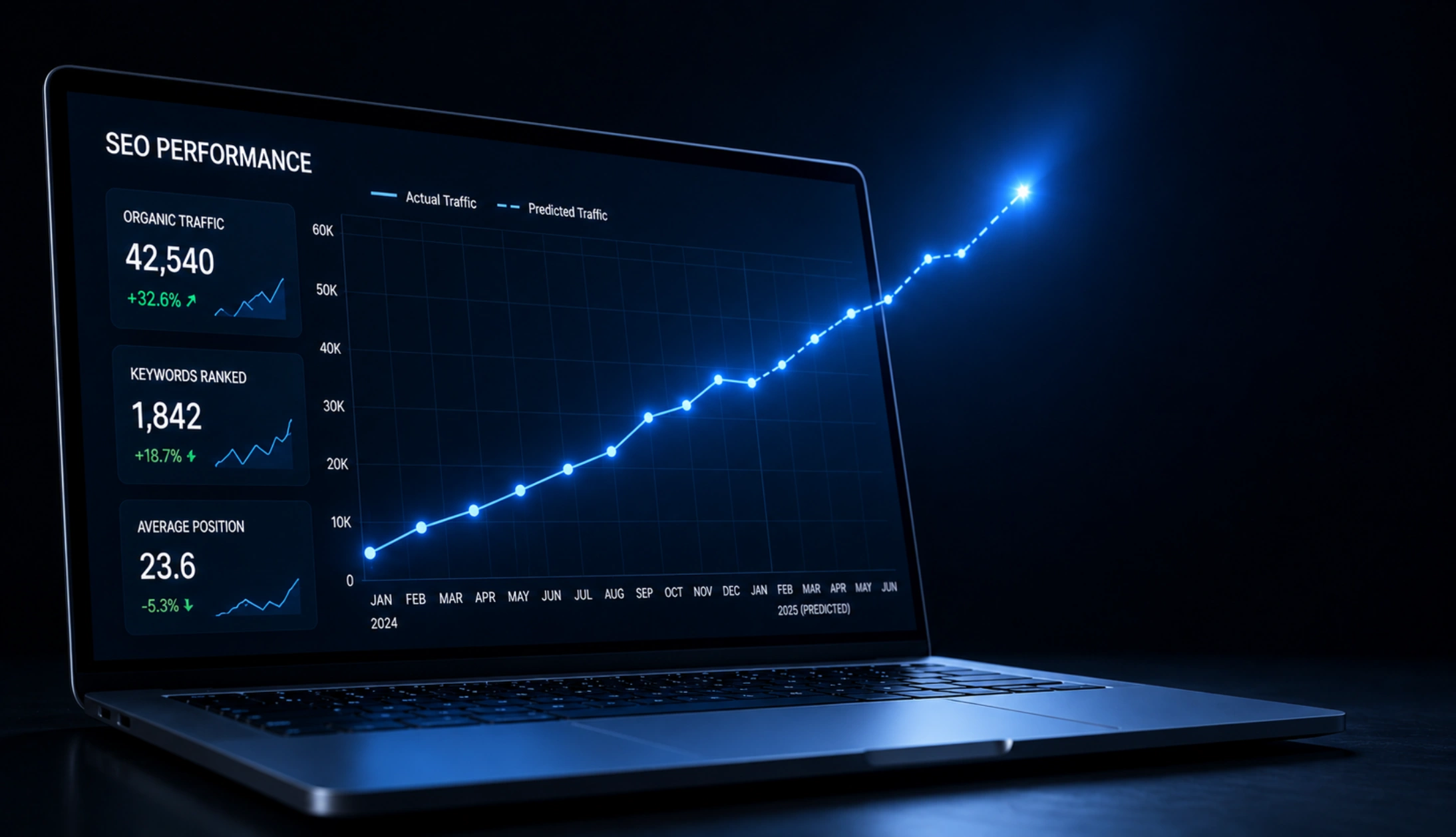
Predictive SEO, powered by artificial intelligence, aims to change that. Instead of looking backward, it looks forward, using data and machine learning to forecast how content will perform before it is published.
But here is the honest question you probably have: Does it actually work? And more importantly, is it something worth paying attention to for your business? That is exactly what this blog will help you figure out.
What is Predictive SEO?
Predictive SEO is the use of artificial intelligence and machine learning to forecast future search rankings and traffic, before content is created or published. Rather than relying on past performance alone, predictive SEO tools analyze patterns across large volumes of data to estimate how a piece of content is likely to perform under current and anticipated search conditions.
It sounds technical, but the core idea is straightforward. If you can predict that a particular topic is about to gain search volume, or that a specific type of content tends to rank faster in your industry, you can act on that information early, before your competitors do. This is why many use AI-powered digital marketing services nowadays to be ahead of competitors.
Traditional SEO vs. Predictive SEO: What Changes?
Traditional SEO is built around observation. You study which keywords people are searching, look at which pages are currently ranking, optimize your content to match those patterns, and measure results after the fact. It is a trial-and-error cycle, and it can be slow and expensive.
Predictive SEO shifts the starting point. Instead of asking “what is working right now?” it asks “what is likely to work next?” AI models look at how search trends evolve, how ranking factors shift over time, and how user intent changes across seasons, industries, and topics. The result is a forward-looking strategy rather than a backward-looking one.
For businesses planning content calendars, allocating SEO budgets, or trying to enter competitive search markets, this shift in timing can make a significant difference. You stop chasing trends and start anticipating them.
How Does AI Forecast Rankings?
To understand how AI forecasts rankings, it helps to first understand why human analysis alone falls short. A single keyword can be influenced by hundreds of variables at once, including domain authority, content quality, backlink profiles, page speed, user engagement, search intent, competitor activity, and more. Tracking all of these factors manually across dozens of keywords is nearly impossible at scale.
AI handles this by processing large datasets quickly and identifying patterns across all of these variables simultaneously. It does not just look at one signal; it looks at how signals interact with each other to produce ranking outcomes, and it learns over time as new data comes in.
What AI Analyzes to Make Ranking Predictions
Ranking prediction models typically draw from several layers of data. They track historical search trends to understand how a topic has grown or declined over time. They monitor competitor content to identify what is currently working in your niche. They analyze algorithm signals, changes in how search engines are weighting certain ranking factors, and adjust predictions accordingly.
They also look at content-level patterns: the structure, depth, readability, and semantic relevance of pages that consistently rank well for similar topics. From all of this, the AI builds a probability model, not a guarantee, but a well-informed estimate of where content is likely to land if it meets certain benchmarks.
How Accurate Are These Predictions?
This is the most important question, and it deserves an honest answer. AI ranking predictions are genuinely useful, but they are not perfect. In stable search environments, where algorithm updates are infrequent and competition is relatively consistent, AI forecasts can be quite accurate. Businesses report better content prioritization, fewer wasted resources, and faster ranking timelines when they act on AI-driven insights.
However, accuracy drops when unpredictable events occur. A major Google algorithm update, a sudden shift in user behavior, or a viral news story can rewrite the ranking landscape overnight. AI models are trained on historical patterns, and when those patterns break, forecasts need to be recalibrated.
The realistic expectation is this: predictive SEO gives you better odds, not certainty. Think of it like a weather forecast. It will not always be right, but it gives you far more to work with than going in blind.
How Does AI Forecast Traffic?
Many people assume that ranking predictions and traffic predictions are the same thing. They are not, and understanding the difference is important before you put too much stock in either.
A high ranking does not automatically mean high traffic. A page ranking in position one for a keyword with low search volume will always generate less traffic than a page ranking in position three for a high-volume keyword. Similarly, if your result appears below a featured snippet, a set of paid ads, and a knowledge panel, your actual click rate may be much lower than your ranking position suggests.
Traffic forecasting accounts for all of this. It goes beyond asking where content will rank and asks how much traffic that rank is actually likely to generate.
What Goes Into a Traffic Forecast?
A traffic forecast combines several layers of estimation. The first is search volume, how many people are searching for a given keyword in a given period. The second is click-through rate modeling, what percentage of searchers at a given ranking position who are likely to click your result, based on the type of query, the appearance of your listing, and the presence of other features on the search results page.
The third layer is seasonality. Many keywords behave very differently across different months. A topic that peaks in January may be almost invisible in July. AI models factor in seasonal trends to produce time-adjusted traffic estimates, not just average figures that smooth over these patterns.
Finally, AI incorporates user behavior signals, things like average session duration, bounce rates, and engagement patterns, to estimate not just how many people will arrive, but how likely they are to stay and convert.
Where Traffic Forecasting Helps the Most?
Traffic forecasting becomes particularly valuable in three areas. The first is content planning. When you can estimate which topics are likely to generate meaningful traffic over the next three to six months, you can build a content calendar around real projected outcomes rather than assumptions.
The second is seasonal campaign timing. If your business has peak periods, a retail business heading into the holiday season, for example, traffic forecasting helps you understand when to publish content to capture demand at its highest point, rather than missing the window.
The third is budget allocation. When you can rank potential content investments by their likely traffic return, you can make far more disciplined decisions about where to focus your SEO effort and spend.
What Can Predictive SEO Actually Do for Your Business?
Understanding the technology is one thing. Understanding what it means for your day-to-day business decisions is another. Here is where predictive SEO moves from an interesting concept to a practical advantage.
Smarter Content Decisions Before You Invest
One of the highest costs in SEO is producing content that does not perform. Long-form articles, landing pages, video scripts, and blog posts all take time and money to produce. When those investments are guided by guesswork, rather than data, a significant portion will simply not deliver results.
Predictive SEO reduces that waste. By analyzing which topics have strong ranking potential, which content structures tend to perform well in your niche, and which keywords are building momentum before they peak, AI helps you make informed decisions before you spend a single dollar on content production. You are not eliminating risk entirely, but you are substantially improving your starting position.
Staying Ahead of Competitors
In competitive search markets, timing is everything. Being the first to publish strong content on a topic that is beginning to trend can earn you backlinks, authority, and a ranking position that is very difficult for competitors to displace later.
Predictive SEO gives you a timing advantage. When AI identifies that a keyword or topic is showing early signals of rising search interest, you have an opportunity to act before that interest reaches its peak, and before your competitors notice the same trend. In highly competitive industries, this kind of early-mover advantage is not small. It can define which brands dominate certain search territories for years.
Better ROI on SEO Spend
SEO can be expensive when approached without direction. Agency fees, content production costs, technical optimizations, and link-building efforts all add up quickly. The return on that investment depends almost entirely on whether you are targeting the right opportunities in the right way.
Predictive SEO sharpens that focus. When your strategy is guided by AI-generated forecasts rather than broad assumptions, you concentrate effort where it is most likely to produce results. Fewer resources go toward low-potential topics. More effort goes toward high-confidence opportunities. Over time, that shift in resource allocation produces a meaningfully better return on your SEO investment.
Where Predictive SEO Falls Short
Predictive SEO is powerful, but it is not perfect. Before you invest, here are three limitations you should know about.
It Cannot Keep Up With Algorithm Updates in Real Time
AI models are trained on historical data. When Google rolls out a major core update, those models may still reflect how rankings worked before the change, producing forecasts that no longer match reality. There is always a recalibration lag, and during that window, predictions can mislead.
It Cannot Predict Black Swan Events
A sudden global event, an economic shift, or a viral cultural moment can rewrite search behavior overnight. No model trained on past patterns can anticipate something it has never seen. When the unexpected happens, real-time human monitoring matters more than any forecast.
It Cannot Make Strategic Decisions for You
An AI tool can flag a keyword as high-potential. It cannot tell you whether that keyword fits your brand, serves your audience, or aligns with your business goals. Those calls still require human judgment. The forecast is an input, not a strategy.
Is Predictive SEO Right for You?
The honest answer depends on where you are in your SEO journey. Here is a simple way to think about it.
If You Are a Small Business or Just Starting Out
Predictive SEO tools add the most value when there is volume to work with. If you are publishing a handful of posts a month for a local audience, the priority should be strong fundamentals — solid technical SEO, consistent content, and a focused keyword list. Get that right first, then layer in predictive tools as your output grows.
If You Are a Growing or Mid-Sized Business
This is where predictive SEO starts to pay off clearly. When you are managing a growing content calendar, competing in a broader market, and making real budget decisions around SEO, AI forecasting removes the guesswork. You know which topics to prioritize, which content formats tend to rank, and when to publish — before you commit resources.
If You Are an Enterprise or High-Volume Publisher
At scale, predictive SEO is not optional — it is essential. Managing thousands of keywords, tracking competitor movements across multiple markets, and allocating large SEO budgets without AI-driven forecasting means leaving a significant competitive advantage on the table. The bigger the operation, the more a bad content bet costs — and the more a well-timed one pays off.
Final Thought:
So, can AI really forecast rankings and traffic? Yes. Not perfectly, and not without limitations, but well enough to make a real difference for businesses that are serious about SEO.
Predictive SEO does not replace the fundamentals. Great content, strong technical optimization, and genuine authority in your subject area are still the bedrock of long-term search performance. What predictive SEO does is make those efforts smarter — helping you focus on the right topics at the right time, reduce wasted investment, and act on opportunities before your competitors do.
If you are at a stage where SEO is a meaningful part of your growth strategy and you are producing content consistently, exploring AI-powered forecasting tools is a logical and well-timed move. The technology is mature enough to be genuinely useful, and the businesses using it today are building ranking advantages that will compound over time.
The goal of this blog was simple: to help you make a clear, informed decision, not to overwhelm you with hype or technical complexity. Hopefully, you now have a solid enough picture to decide whether predictive SEO deserves a place in your strategy. The answer, for most growing businesses, is yes.