Over 60% of Google Searches now end without a click due to tools like Google’s AI overviews, Perplexity, and other AI-powered platforms [source: Originality]. Search engines are not what they used to be. Today, when users ask a question online, they get the answer right on the result page, without any clicks.
Instead of showing users a list of websites, search engines now pull answers directly from top sources, so if your content is not structured to be picked up by AI, it might never be seen. This is where Answer Engine Optimization (AEO) enters the picture. You can use it to show up your content in AI answers, voice search, and featured snippets. AEO is about being the answer, not the link.
What is AEO and Why Does It Matter?
Answer Engine Optimization, or AEO, is a new way of writing and organizing your content so AI-powered tools, like ChatGPT, Google SGE (search generative experience), Bing Copilot, and voice assistants, can easily find and use it to answer people.
Why Does It Matter? Your content will show up in answer boxes, AI summaries, or voice replies, often right at the top of the page. Even if your SEO is strong, your content might be invisible to AI tools if not structured for AEO.
But, What’s The Difference Between Traditional SEO and AEO?
| Feature | Traditional SEO | AEO |
| Goal | Ranks website on search results | Get your website content featured in AI-generated answers |
| Placement | Appears in the list of links (below sponsored ads) | Appears in ‘Position Zero’ or answer boxes |
| Focuses On | Keywords, backlinks, page authority | Clarity, structure, and direct answers |
| User Action | Clicks on the link to your site | Gets the answer instantly, no clicks |
How AEO Works?
AEO helps AI engines in finding and using your content to answer user queries directly. Here’s how:
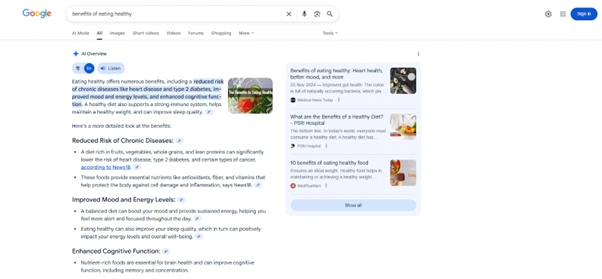
Step 1 – User asks a query: E.g., benefits of eating healthy [figure 1].
Step 2 – The AI engine uses natural language processing (NLP) to find out what the person really wants to know.
Step 3 – It scans tons of websites and pages to find the most relevant, well-structured, and trustworthy content.
Step 4 – The AI pulls the best information and creates a short, clear response, like a short paragraph, bullet points, summary, etc., as an answer to the user query.
Step 5 – It lists the source websites from where it found helpful and well-organized information. That’s your win!
So, to succeed with AEO, your content must be –
- Clear to read and understand
- Structured and well-organized with headings, lists, and schema markup
- Relevant and focused on giving answers to real-world questions
Tip: Platforms like Google’s AI Overviews, ChatGPT, Siri, and Bing Copilot rely on these signals, not just keywords or backlinks.
What Are The Benefits Of AEO For Users?
The entire concept of answer engine optimization is designed with the ‘user first’ in mind, and it has been a game-changer due to the following reasons:
- Fast Answers – People get answers instantly without clicking through pages.
- Speed & Efficiency – AI tools deliver answers within seconds, which saves time.
- Convenience – It works great with mobile and voice searches, where users want quick, spoken replies.
- Improved Experience – It feels more conversation than hunting for relevant links.
- More Trust – A clear and direct answer builds credibility and reduces confusion.
Did You Know That … featured snippet gets about 8% of all clicks? So, aim to add a 40 to 60-word snippet to your webpage [source: Backlinko].
Tip: Match your content with how people search these days. For example, instead of writing ‘leaky faucet fix’ write ‘how do I fix a leaky faucet?’, for better results.
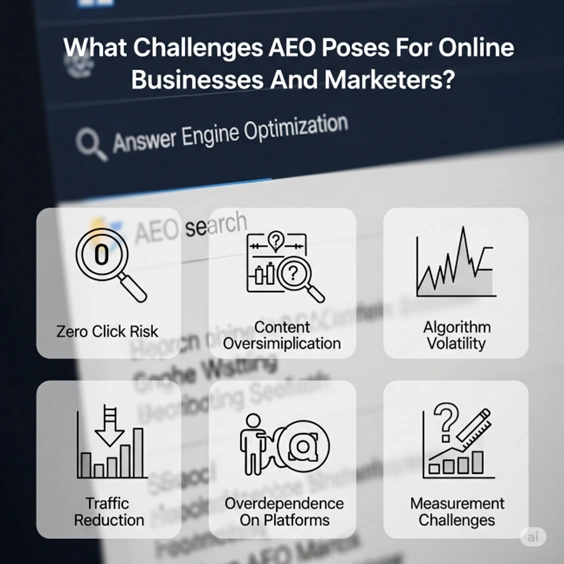
What Challenges AEO Poses For Online Businesses And Marketers?
Here’s what marketers need to watch out for when dealing with AEO:
1. Zero Click Risk – More and more searches are getting ‘zero-clicks’, meaning users get answers without visiting a website.
2. Content Oversimplification – Trying to be simple to read may remove important details or context in some cases.
3. Algorithm Volatility – AI engine changes often, so your top answer today may disappear tomorrow.
4. Traffic Reduction – Sectors like health and travel have seen up to a 41% drop in organic clicks due to AI overviews [source: Pingback].
5. Overdependence On Platforms – Your visibility will depend on how Google, Bing, or ChatGPT displays your content, as AI can misinterpret or oversimplify your message.
6. Measurement Challenges – Traditional SEO metrics like bounce rate or time on page don’t apply here, so you will need to track:
- Visibility in AI answers
- Brand mentions
- Snippet coverage
Summary? To stay ahead, marketers and businesses need to rethink how they measure success and how they write content.
How To Make Your Website And Content AEO-Friendly?
Making your content AEO-friendly means helping AI tools to understand, extract, and deliver your answers clearly and quickly to users. Here’s how you can do it:
1. Use Question-Based Headings:
Make sure to frame your headings (H2 or H3) as natural questions people actually ask. This will help AI engines to match your content to real user queries. For example:
- ‘What is AEO?’
- ‘How does AEO help users?’
2. Write Answers, Not Just Keywords:
You can choose long-tail, question-style keywords and give a direct answer in 40 to 60 words right after the heading. Then you can add more details, examples, or context below it. For example:
- Car insurance tips 🗶
- How to save money on car insurance? ✔
3. Structure Your Content For AI Engines:
Use clear headings that ask questions, then put the main answer in the first paragraph, and then use bullet points or a numbered list for steps or definitions.
Tip: Keep paragraphs short and easy to read.
4. Add Structured Data/ Schema Markup:
A schema is a small piece of code that helps search engines to understand the content of a webpage in a better way. You can add the following:
- FAQ pages (with schema markup)
- How Tos
- QA Page
- Alt Text (that answers questions apart from describing the image)
Tip: You can use helpful tools like Google Structured Data Markup Helper, RankMath, Yoast SEO, or ask a digital marketing agency for professional help to get schema right.
5. Build Your Authority:
AI engines prefer content from trusted sources, so focus on E-E-A-T, i.e.:
- Expertise
- Experience
- Authoritativeness
- Trustworthiness
Tip: Make sure to include author bios with credentials, citations to reliable sources, and updated timestamps to show the freshness of your content.
6. Improve Page Speed & Mobile Experience:
AI engines favor fast-loading pages, so make sure your website works well on phones and tablets. You can use tools like Google PageSpeed Insights to test and improve performance.
7. Optimize For Voice Search:
About 20.5% of people worldwide use voice searches for their queries, and about 27% of people use voice search on their mobile devices [source: DemandSage]. Voice searches are conversational and question-based, so AEO naturally fits this style.
Make sure to make your content sound more natural and helpful, as if you are answering a friend. For example,
- Energy-efficient homes 🗶
- How can I make my home energy-efficient? ✔
Want To Be In AEO Answers? Start Optimizing For AEO Today
The way people interact with searches is changing, and AEO is your ticket to staying visible. It helps your content appear in AI-generated responses, voice assistants, and zero-click results.
It’s the next step that marketers and businesses must adapt early to earn trust, engagement, and top placement in the AI-driven search world. You can start small by:
- Restructuring the key pages
- Adding schema markup
- Writing clearly and concisely
The goal is no longer traffic but to become a go-to source that answers real questions. Adapt now, and you won’t just keep up, you will lead in the new search frontier.